Technique
Aperture, Depth of Field and Hyperfocal Distance for Night Landscapes
At night the aperture does two jobs at once. It sets how much light reaches the sensor, and it sets how much of the scene, from the rock at your feet to the stars, is sharp. Daytime habits ("f/11 for landscapes") don't work after dark, and the hyperfocal distance advice engraved on old lens barrels is slightly wrong for stars. This guide explains hyperfocal distance for people who shoot at night, and how to choose an aperture once you understand it.
At a glance
- Settings: a fast prime one stop down (f/2–2.8), an f/2.8 zoom at f/2.8–3.5, a kit lens wide open with the ISO raised. Use f/8–11 for the Moon and daytime landscapes.
- Where to focus: on the stars, at 100% magnification, whenever the nearest foreground is farther than about twice the hyperfocal distance, roughly 30 feet for a 20 mm at f/2.8.
- Close foregrounds: a foreground inside the hyperfocal distance needs a compromise focus, or two frames blended.
- Why not wide open: coma, astigmatism and vignetting turn corner stars into wings and smudges. Stopping down half a stop to one stop usually improves the picture more than the lost light hurts it.
What the f-number is
The f-number is the focal length divided by the diameter of the entrance pupil, the aperture as seen through the front of the lens. A 50 mm lens at f/2 has a 25 mm pupil, and a 20 mm at f/2 has a 10 mm one. The same f-number gives the same image brightness on any lens because it's the ratio that matters, not the size of the hole.
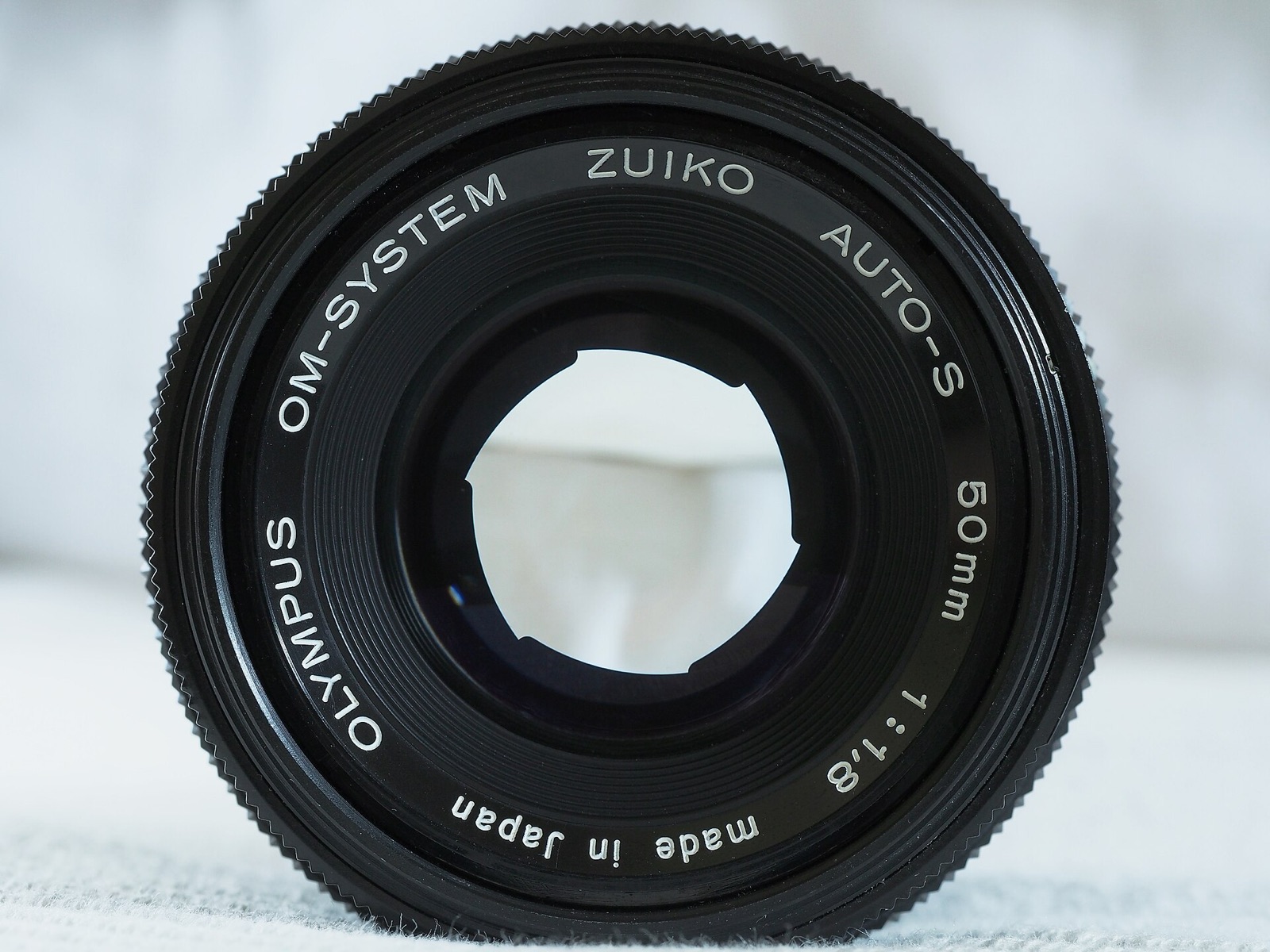

The full-stop sequence runs f/1, 1.4, 2, 2.8, 4, 5.6, 8, 11, 16, 22. Each step multiplies the f-number by √2 ≈ 1.41, which halves the pupil's area and halves the light. That's one stop, the same unit as doubling the ISO or the shutter time. So f/2.8 to f/4 is a full stop, which is a big change. At night the shutter is already limited by star motion, so it means ISO 3200 instead of 1600, or 25 s instead of 13 s and trailed stars. Every row below records the same amount of light.
| Aperture | Shutter | ISO | Note |
|---|---|---|---|
| f/1.4 | 1 s | 800 | Wide open. Corner stars usually poor. |
| f/2 | 2 s | 800 | One stop down. Cleaner stars. |
| f/2.8 | 4 s | 800 | Two stops down. Typical for f/2.8 zooms. |
| f/2.8 | 2 s | 1600 | Same light: shorter shutter, more gain |
| f/4 | 4 s | 1600 | What you lose with an f/4 lens compared with row 3 |
Depth of field at night
A lens focuses exactly one distance onto the sensor. Everything nearer or farther comes out as a small blurred disc instead of a point. Depth of field is the range of distances where that disc is still too small to notice, meaning smaller than the circle of confusion (CoC). The convention is the sensor diagonal divided by about 1,500: 0.029–0.030 mm on full frame, about 0.019 mm on APS-C, 0.015 mm on Micro Four Thirds. It assumes a modest print viewed at arm's length, so it means "sharp enough in a print", not "pixel-sharp at 100%". That difference matters for stars, as you'll see below.
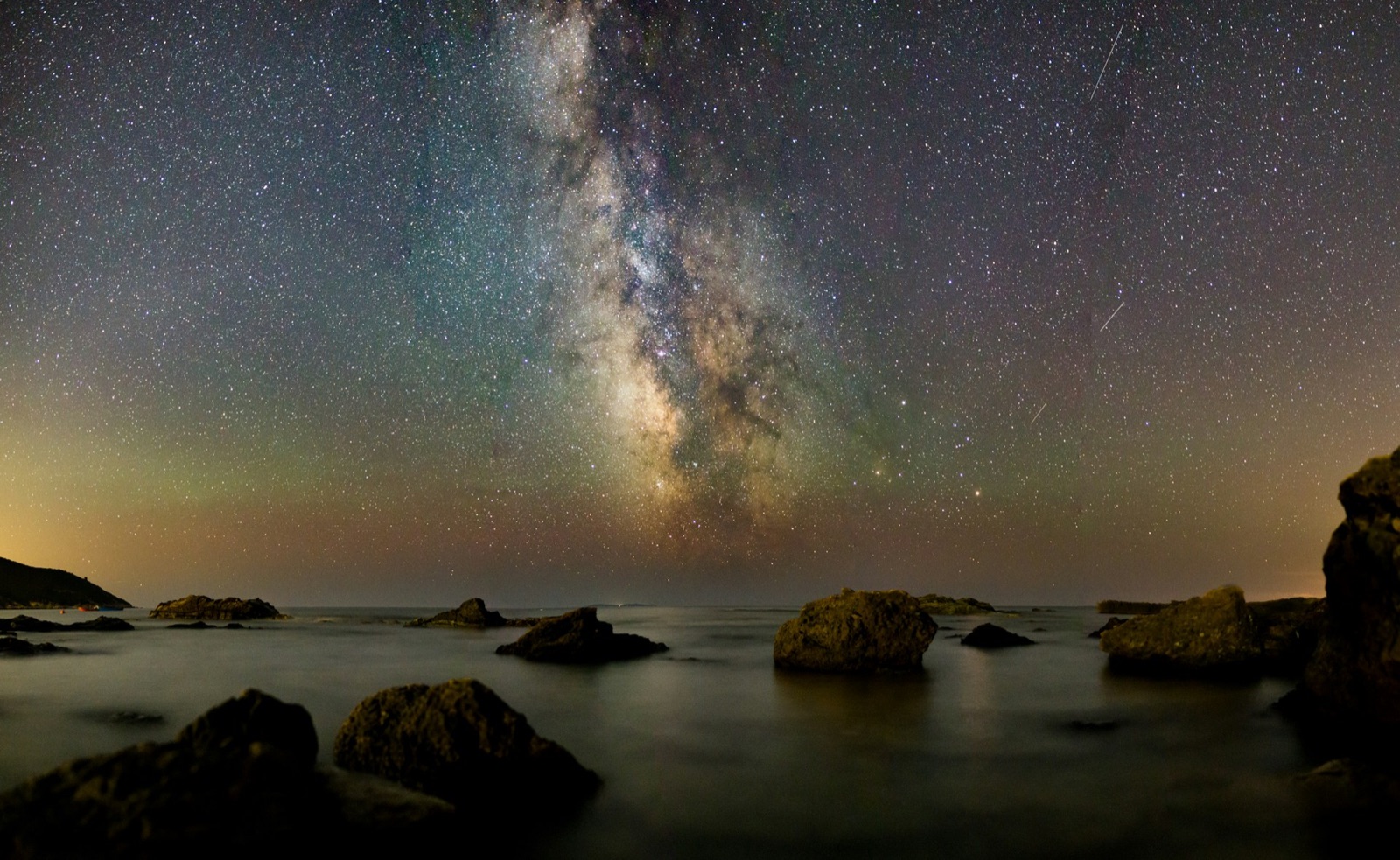
Three things set it:
- Aperture. A smaller pupil makes smaller blur discs, and depth of field grows roughly in proportion to the f-number.
- Focal length. Depth of field shrinks with the square of focal length. Halve the focal length and you get four times the depth of field.
- Focus distance. The farther you focus, the deeper the sharp zone. At the hyperfocal distance it reaches infinity.
Short focal lengths are what make night landscapes possible. A 14–20 mm lens at f/2.8 keeps a scene sharp from a few yards out to the stars without stopping down. A 50 mm at the same aperture doesn't.
Hyperfocal distance explained
The hyperfocal distance H is the nearest focus distance at which infinity is still acceptably sharp. Focus there and the depth of field runs from H/2 to infinity. The formula:
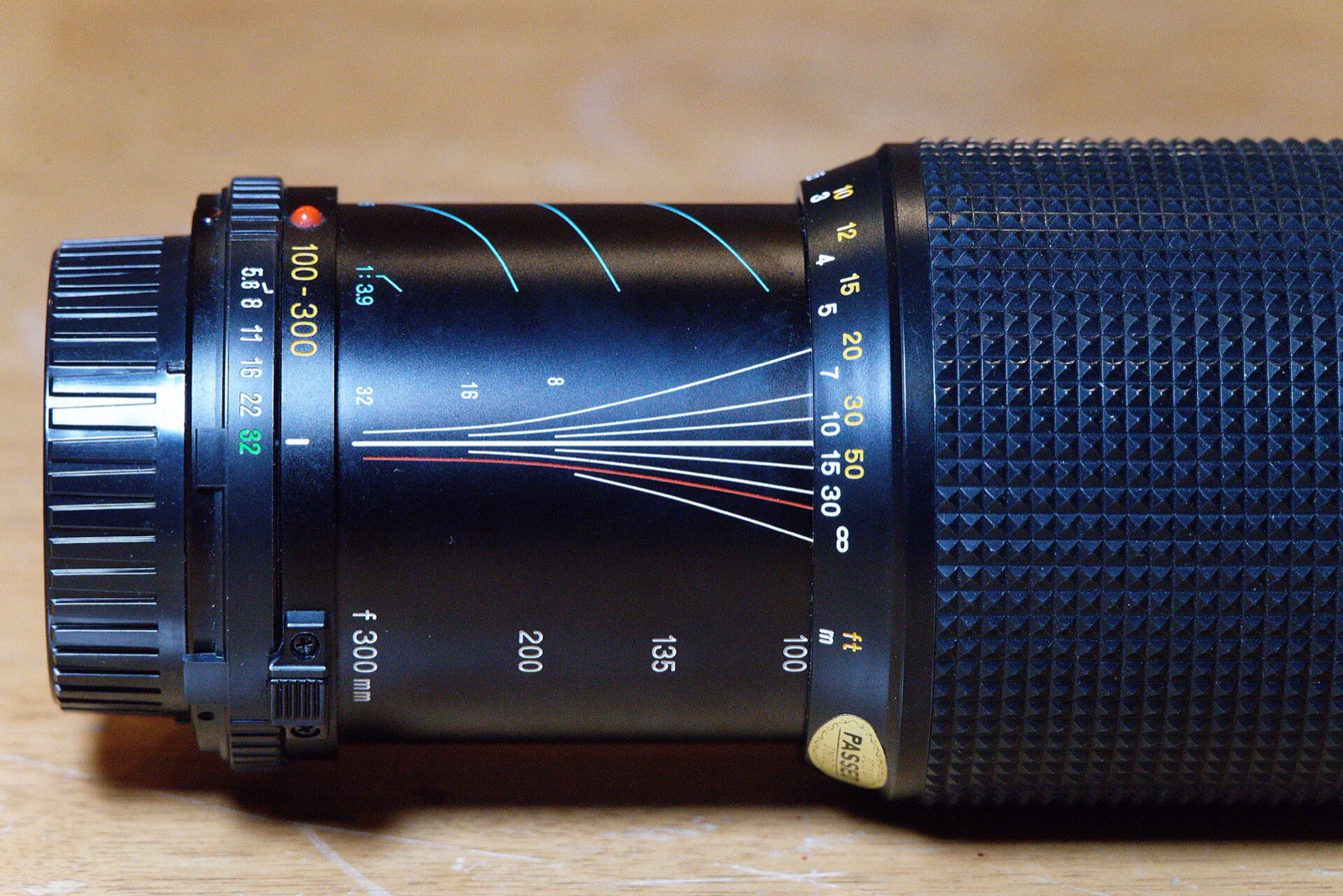

H = f² / (N · c) + f, which is focal length squared, over f-number times circle of confusion, plus one focal length (small enough that most calculators drop it).
Computed for full frame with c = 0.030 mm, rounded:
| Focal length | f/1.4 | f/2 | f/2.8 | f/4 |
|---|---|---|---|---|
| 14 mm | 15 ft | 11 ft | 7.7 ft | 5.4 ft |
| 16 mm | 20 ft | 14 ft | 10 ft | 7.1 ft |
| 20 mm | 31 ft | 22 ft | 16 ft | 11 ft |
| 24 mm | 45 ft | 32 ft | 23 ft | 16 ft |
| 35 mm | 96 ft | 67 ft | 48 ft | 34 ft |
| 50 mm | 195 ft | 137 ft | 98 ft | 69 ft |
On APS-C the smaller CoC pushes every figure out by about 1.6×. A 20 mm at f/2.8 has a hyperfocal distance of roughly 25 feet rather than 16 feet. But a 20 mm on APS-C frames like a 30 mm on full frame, so for the same view at the same f-number the crop sensor has slightly more depth of field, because it's using a shorter lens.
Focus on the stars, not at the hyperfocal distance
There's a problem with "focus at hyperfocal". Stars are at infinity, and at hyperfocal focus infinity sits on the far edge of the depth of field, so it comes out as a blur disc exactly the size of the acceptable limit. A 0.030 mm disc on a 24-megapixel full-frame sensor is about five pixels across. A rock still looks fine with that much blur. A star should be a point one or two pixels wide, and it turns into a soft blob, along with every other star in the frame. We've seen a lot of otherwise good Milky Way frames ruined this way by advice that was written for daylight.
- Find the hyperfocal distance for your lens and aperture from the table.
- If the nearest thing you care about is farther than about 2×H, focus on the stars. Use live view on a bright star at 100% magnification and turn the ring until the star is as small as it gets. The foreground is well inside the sharp zone. At 2H its blur is half the limit.
- If it's between H and 2H, star focus still works and the foreground is acceptable but not sharp. If you focus slightly nearer, the blur is shared between the stars and the foreground.
- If it's nearer than H, one frame can't hold both. Shoot two frames and blend them (below), or accept a soft sky.
Turning the ring to the stop doesn't focus at infinity either, because most lenses focus past it to allow for temperature. The focusing at night guide covers the live-view method step by step.
Worked example: 20 mm, f/2.8, rock at 10 ft
On full frame, a 20 mm at f/2.8 has H ≈ 16 feet and 2H ≈ 31 feet. A boulder 10 feet away is inside the hyperfocal distance. These are the options:
- Focus on the stars. The stars are sharp. The rock's blur disc is about 0.047 mm, 1.6× the limit. It's visibly soft at full size but passable in a small print.
- Focus at hyperfocal, 16 feet. In theory everything is sharp from 7.8 feet outward, but the stars sit at the 0.030 mm limit and look soft.
- Focus at about 20 feet. Rock and stars both come out at roughly 0.023 mm of blur. Each is just inside the limit and neither is perfect. This is the best you can do in a single frame.
- Two frames. One focused on the stars, one on the rock, blended in post. Both are sharp (see stacking, below).
Step back to 35 feet from the rock and the problem goes away. The rock is now beyond 2H, so star focus covers everything. Moving back is often the easiest fix.
Best aperture for astrophotography: the lens wide open
Aperture also affects how well the lens renders stars, and that's often the better reason to stop down. Every fast lens has aberrations that are worst wide open and get smaller as the aperture blocks off the outer part of the glass.
- Coma turns off-axis stars into small comets or seagull shapes, worst in the corners.
- Astigmatism stretches them into short lines, tangential (radiating from the centre) or sagittal (arcs around it). It's the hardest aberration to correct.
- Vignetting darkens the corners by a stop or two on many fast primes, so the corner sky is noisier than the centre.
- Sagittal flare puts faint wings on bright stars near the edge, which is typical of a fast wide-angle at full aperture.
One stop down cuts coma a lot and brightens the corners. Two stops down usually gets the best out of a lens. Going from f/1.4 to f/2 loses one stop of light, which you can get back by doubling the ISO. You can't fix bad corner stars afterwards. Test your own lens once: shoot a star field at each aperture and look at the corners at high magnification. It takes about half an hour and you only have to do it once for each lens.
| Lens type | Shoot at | Why |
|---|---|---|
| Fast prime, f/1.4–1.8 | f/2–2.8 | One to two stops down cleans up coma and vignetting. Even stopped down there should be enough light. |
| f/2.8 zoom or prime | f/2.8–3.5 | Wide open if the corners pass your test. If not, a third to half a stop down. |
| Kit zoom, f/3.5–5.6 | Wide open, wide end | No light to spare. Raise the ISO and use the NPF-limited shutter. |
| Telephoto for the Moon | f/8–11 | Depth of field doesn't matter here. This is where the lens is sharpest. |
Camera Tools works from your actual lens and sensor. It gives the field of view for any focal length and format, and the NPF and 500 rules for the longest shutter before stars trail at the aperture and pixel pitch you enter. The exposure recipes per subject (Milky Way, Moon, Sun, meteors, eclipses) give a starting aperture, shutter and ISO to adjust from.
Diffraction, and the Moon
Closing the aperture far enough makes everything softer, not sharper. Light passing a small opening spreads, and a point becomes an Airy disc about 2.44 × wavelength × f-number across. For green light that's roughly 1.34 µm per f-stop unit: 10.7 µm at f/8, 14.7 µm at f/11, 21.4 µm at f/16. Resolution suffers once the disc spans two to three pixels. A 24-megapixel full-frame sensor has pixels about 6 µm across, so softening starts around f/11 and is obvious by f/16. At 45 megapixels the pixels are about 4.4 µm, and it shows from about f/8 and clearly at f/11. For daytime landscapes that means f/8–11 rather than f/16 unless you need the depth of field.
For the Moon, depth of field doesn't matter. The Moon is 239,000 miles away, which is infinity for any lens. Focus on a crater at 100% and the whole disc is in focus at any aperture. Choose the aperture for lens sharpness instead. Most telephotos are at their best at f/8 to f/11, before diffraction starts to soften them. For exposure use the Looney 11 rule: f/11 and a shutter of 1/ISO seconds (1/200 s at ISO 200) for a full Moon well up in the sky. That's one stop more than Sunny 16 because the lunar surface is dark grey rock. Open a stop or two for a crescent or a low Moon.
Focus stacking for close foregrounds
When the foreground is inside the hyperfocal distance, take two or three frames instead of one:
- Lock the tripod. Only the focus ring should move between frames.
- Frame one: focus on the stars at 100%, at the NPF or 500-rule shutter.
- Frame two: focus on the foreground. Use the same aperture. The shutter can be longer because a rock doesn't trail. Add a third frame at a distance in between if the foreground is deep.
- Blend in post with a layer mask along the horizon.
Phones
A phone's "24 mm" or "26 mm" lens is an equivalent figure. The physical focal length, behind a sensor about 10 mm across, is 6–7 mm (a current flagship main camera is about 6.9 mm at f/1.8). Depth of field follows the physical length, squared, so a phone at f/1.8 has a hyperfocal distance of around 10 feet, which is more depth of field than a full-frame 24 mm at f/16. Portrait mode's blur is computed from a depth map, not made by the lens, and it doesn't matter after dark. The problem with phone night shots is light, not focus. A phone has a pupil of about 4 mm, against 10 mm or more on a fast full-frame wide-angle.
In the Planner, the camera field-of-view overlay draws what your focal length and sensor cover from the spot you stand on, over the map, alongside the Sun and Moon direction lines and the altitude curves for the time you pick. You can check whether a 20 mm takes in the whole ridge and the Milky Way core before you leave the house.
Common mistakes
- Focusing at the hyperfocal distance for a star field. The stars end up at the edge of acceptable sharpness. Focus on them.
- Turning the ring to the infinity stop. Most lenses focus past infinity, so check focus at 100%.
- Shooting at f/1.4 because the lens can. Check the corners first. They're usually better at f/2.
- f/11 at night out of daytime habit. You lose four stops of light to get depth of field a 20 mm lens already had.
- Stopping a telephoto down for the Moon. It's at infinity, so all you add is diffraction.
FAQ
What is the best aperture for Milky Way photography?
The widest aperture at which your lens gives round corner stars, typically f/2–2.8 on a fast prime and f/2.8 on an f/2.8 zoom. Kit lenses go wide open with the ISO raised.
Should I focus on the stars or at the hyperfocal distance?
On the stars, whenever the nearest foreground is farther than about twice the hyperfocal distance, around 30 feet for a 20 mm at f/2.8 on full frame. Hyperfocal focus leaves the stars at the limit of acceptable sharpness, and they look soft.
How do I calculate hyperfocal distance?
H = f²/(N·c) + f, with focal length f and circle of confusion c in millimetres and N the f-number. For a 24 mm at f/2.8 on full frame: 576 / (2.8 × 0.030) + 24 ≈ 6,880 mm. Divide by 304.8 to get 23 feet. Depth of field then runs from 11 feet to infinity.
Does a crop sensor have more depth of field?
For the same framing and f-number, yes, by about the crop factor, because it uses a shorter lens. For the same physical lens the hyperfocal distance is longer on the crop body, because its circle of confusion is smaller.
Sources and further reading
- Wikipedia — Hyperfocal distance (the formula H = f²/(Nc) + f; infinity only acceptably sharp at hyperfocal focus).
- Wikipedia — Circle of confusion (the d/1500 convention: 0.029–0.030 mm full frame, 0.018–0.019 mm APS-C, 0.015 mm Four Thirds).
- Wikipedia — F-number (focal length ÷ entrance pupil; the √2 full-stop sequence).
- Cambridge in Colour — Diffraction Limited Photography (Airy disc size versus f-number; the two-to-three-pixel rule of thumb).
- Lonely Speck — A Practical Guide to Lens Aberrations (coma, astigmatism, vignetting; stopping down one to two stops).
- Wikipedia — Looney 11 rule (f/11 at 1/ISO for the full Moon; one stop more than Sunny 16).