Dark skies
The Bortle Scale Explained: How Dark Is Your Sky, and Where to Find Darker Ones
Two people can stand under the same clear sky and disagree about how dark it is. The Bortle scale gives them a common way to rate it. John Bortle published it in Sky & Telescope in February 2001 because the old measure, the faintest star you could see, depended as much on the observer's eyes as on the sky. His nine classes run from 1, the darkest places on Earth, to 9, the centre of a large city, and each is defined by things you can check for yourself: whether the Milky Way shows structure, whether the zodiacal light is visible, whether a passing cloud looks black or glows. Once you know your class, you know what you can photograph from home and how far you need to drive for the rest.
At a glance
- The scale: classes 1–3 are dark, 4–5 rural to suburban, 6–7 suburban, 8–9 city. Each is tied to an approximate sky brightness in mag/arcsec², where higher numbers are darker.
- Quick test: all seven stars of the Little Dipper (faintest ≈ 5.0) means class 5 or better. A Milky Way with a visible dark rift means class 4 or better. A cloud that glows means class 5 or worse.
- Where to look: light-pollution maps built on the Falchi et al. 2016 World Atlas and VIIRS satellite data, and DarkSky International's 250 certified places.
- When: a Moon-free window. A full Moon turns any site into roughly a class 7 sky.
- Which way: put the city behind you and the darkest horizon toward the target. That's south for the Milky Way core in the northern hemisphere.
The nine Bortle scale classes
Limiting magnitudes are Bortle's own. The mag/arcsec² ranges are the commonly quoted Sky Quality Meter equivalents, not part of the original article, and they're approximate. A site near a boundary can read either class on different nights.
| Class | Name | What you see | Limiting mag. | ≈ mag/arcsec² |
|---|---|---|---|---|
| 1 | Excellent dark site | Zodiacal light obvious and coloured. Milky Way casts shadows. M33 easy to see with the naked eye. Clouds look black against the sky. | 7.6–8.0 | 21.8–22.0 |
| 2 | Truly dark site | Zodiacal light bright and yellowish. Milky Way shows a lot of structure. M33 easy. Airglow near the horizon. | 7.1–7.5 | 21.6–21.8 |
| 3 | Rural sky | Some glow on the horizon. Clouds faintly lit low down. Milky Way still complex. M33 easy with averted vision. | 6.6–7.0 | 21.3–21.6 |
| 4 | Rural/suburban transition | Light domes in several directions. Milky Way impressive but lacking fine detail. M33 difficult. Zodiacal light still visible. | 6.1–6.5 | 20.8–21.3 |
| 5 | Suburban sky | Only hints of zodiacal light. Milky Way washed out overhead, weak near the horizon. Clouds noticeably brighter than the sky. | 5.6–6.0 | 19.3–20.8 |
| 6 | Bright suburban sky | No zodiacal light. Milky Way only near the zenith. M33 needs binoculars. Sky greyish-white within 35° of the horizon. | 5.1–5.5 | 18.5–19.3 |
| 7 | Suburban/urban transition | Whole sky greyish-white. Milky Way invisible or nearly so. M31 barely visible. Clouds brightly lit. | 4.6–5.0 | 18.0–18.5 |
| 8 | City sky | Sky grey or orange, bright enough to read by. Fainter stars missing from the constellations. | 4.1–4.5 | <18.0 |
| 9 | Inner-city sky | Only the Moon, planets, the Pleiades and a few bright stars. | ≤4.0 | — |
What each Bortle class looks like in a photo
Take the standard Milky Way frame, 20 s, f/2.8, ISO 3200, 14–24 mm, from three sites.
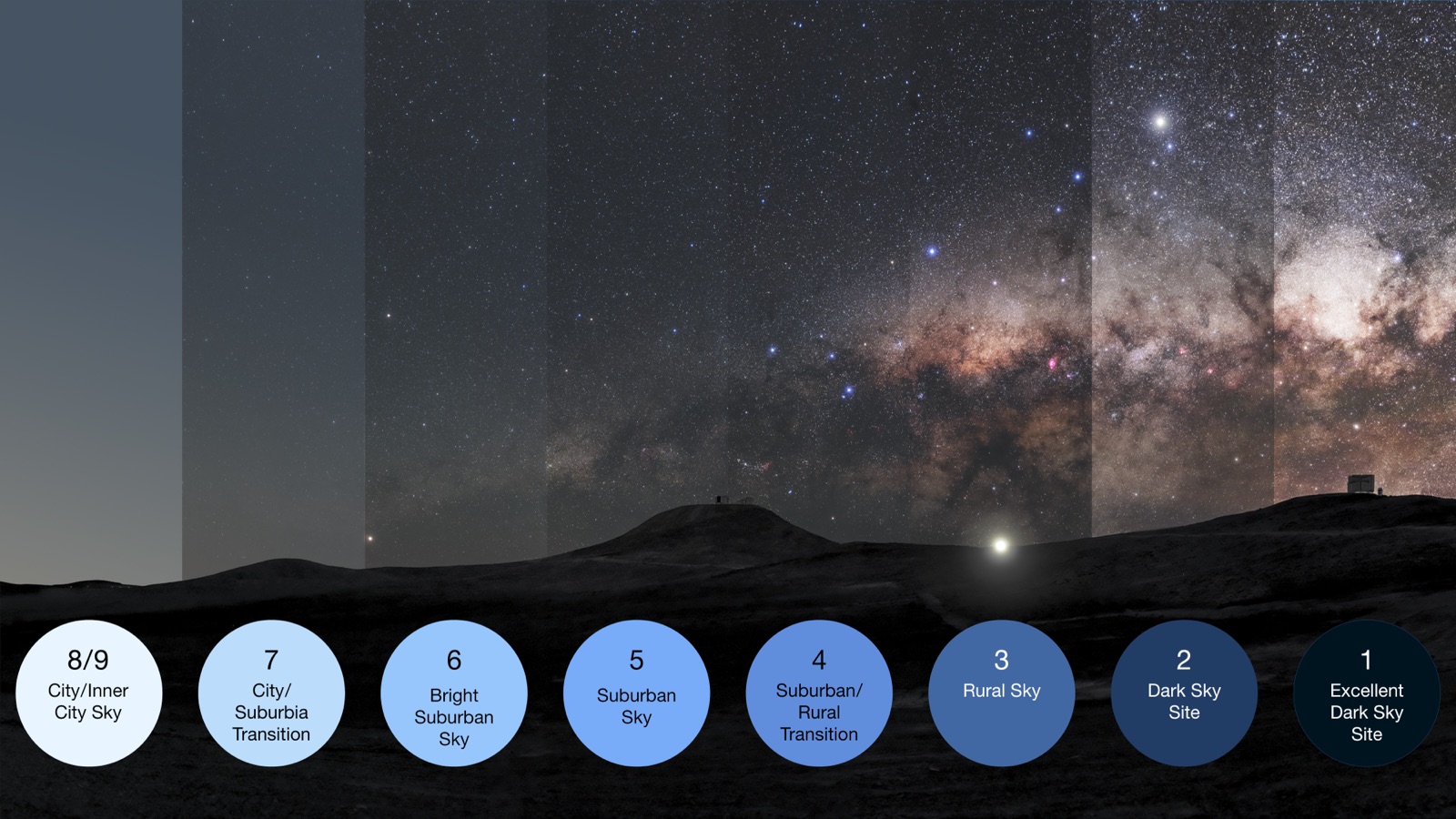
Bortle 8. The frame is tan or orange, brightest at the horizon and only a little darker overhead, and the histogram is pushed to the right. A few dozen stars show. The Milky Way isn't there and stretching won't bring it back, because the camera never recorded it.
Bortle 4. The core is there with its main dark lanes, but the lower third has an orange or yellow-green gradient from the nearest towns, and the core looks soft, as if there were haze. Remove the gradient first when you process.
Bortle 2. The background is dark and neutral in colour. The dust lanes of the Great Rift run the length of the band and the core shows fine mottling. Faint green or red bands near the horizon are airglow, not a town.
How to find your Bortle class without a meter
- Dark-adapt first. Spend twenty minutes without looking at a phone screen or headlights. If you skip this, none of the tests below will work.
- Count the Little Dipper. Polaris and Kochab (magnitude 2.0 and 2.1) are visible anywhere. Pherkad is 3.0, the two middle handle stars 4.2 and 4.4, the faintest two 4.95 and 5.0. All seven means a limiting magnitude of at least 5, so class 5 or better. Only the three brightest means class 7 or worse.
- Count the Pleiades. Six or seven is an ordinary sky. Nine or more is a dark one. Observers with sharp eyes see 11–14 at a class 1–2 site.
- Look for structure in the Milky Way. The question is whether you can see the dark rift splitting the band through Cygnus, not whether you can see the band at all. If you can see the rift, the sky is class 4 or better. A faint smudge only overhead is class 6, and nothing at all is class 7 or worse.
- Try for M31 and M33. The Andromeda Galaxy, magnitude 3.4, is visible to the naked eye with averted vision down to about class 6. The Triangulum Galaxy, magnitude 5.7 spread over a wide patch, needs class 3 or better, and direct vision only works at class 1–2.
- Watch a cloud. This is the most reliable test. In a dark sky a cloud is a black patch with no stars in it. In a polluted sky it glows, because it reflects the city's light back down. A cloud brighter than the sky around it means class 5 or worse.
Bortle scale maps, meters and phone apps
Light-pollution maps are built on two datasets. The first is the World Atlas of Artificial Night Sky Brightness by Fabio Falchi and colleagues (Science Advances, 2016), which modelled skyglow worldwide from satellite radiance calibrated against more than 35,000 ground measurements. It found that more than 80% of the world's population, and more than 99% of people in the United States and Europe, live under light-polluted skies. The Milky Way is hidden from more than a third of humanity, including 60% of Europeans and nearly 80% of North Americans. The second is the raw satellite data from the VIIRS Day/Night Band on the Suomi NPP satellite, which has imaged Earth's night lights since 2012.
lightpollutionmap.info overlays both on a road or satellite map (choose "World Atlas 2015" for modelled sky brightness) and plots SQM readings uploaded by observers. Keep two things in mind. The atlas is a 2014-era model and towns have grown since then. A satellite also can't see the ridge that hides a town from your site. Use the map to make a shortlist, then go and look.
A Sky Quality Meter is a hand-held photometer that reads the zenith directly in mag/arcsec². Dark Sky Meter (iPhone) does roughly the same job with the phone camera. Loss of the Night (iOS and Android) takes you through the limiting-magnitude test star by star for a citizen-science project. Neither is as good as a meter, but both are better than guessing.
Certified dark sky parks and reserves
DarkSky International (the International Dark-Sky Association until 2023) certifies parks, reserves, sanctuaries and communities that meet sky-quality and lighting standards. The programme passed 250 places in November 2025. Certification is about lighting policy as much as darkness, so a certified park isn't automatically darker than the empty desert next to it. What it does have is legal access at night and a plan for keeping the lights off. That matters when you're there at 2 am.
| Place | Where | Type | Certified | Note |
|---|---|---|---|---|
| Natural Bridges National Monument | Utah, USA | Park | 2007 | The first International Dark Sky Park. |
| Cherry Springs State Park | Pennsylvania, USA | Park | 2007 | Class 2 sky. The first in the eastern US. |
| Death Valley National Park | California/Nevada, USA | Park | 2013 | Gold tier. The largest park in the programme. |
| Exmoor National Park | England | Reserve | 2011 | Europe's first Dark Sky Reserve. |
| NamibRand Nature Reserve | Namibia | Reserve | 2012 | Africa's first. 830 square miles of desert. |
| Aoraki Mackenzie | South Island, New Zealand | Reserve | 2012 | 1,686 square miles. The largest reserve when certified. |
How far from the city do you need to go?
There's no exact formula, because terrain, humidity and the town's lighting all matter. Observers use rough rules, and these agree with the maps. For a town of 10,000, go 15–25 miles. For a city of 100,000, go at least 20–30 miles, which is also NASA's minimum for faint objects. For a city of a million or more, go 60 miles and often twice that. You can see the glow of a large metropolitan area on the horizon from 50–100 miles away.
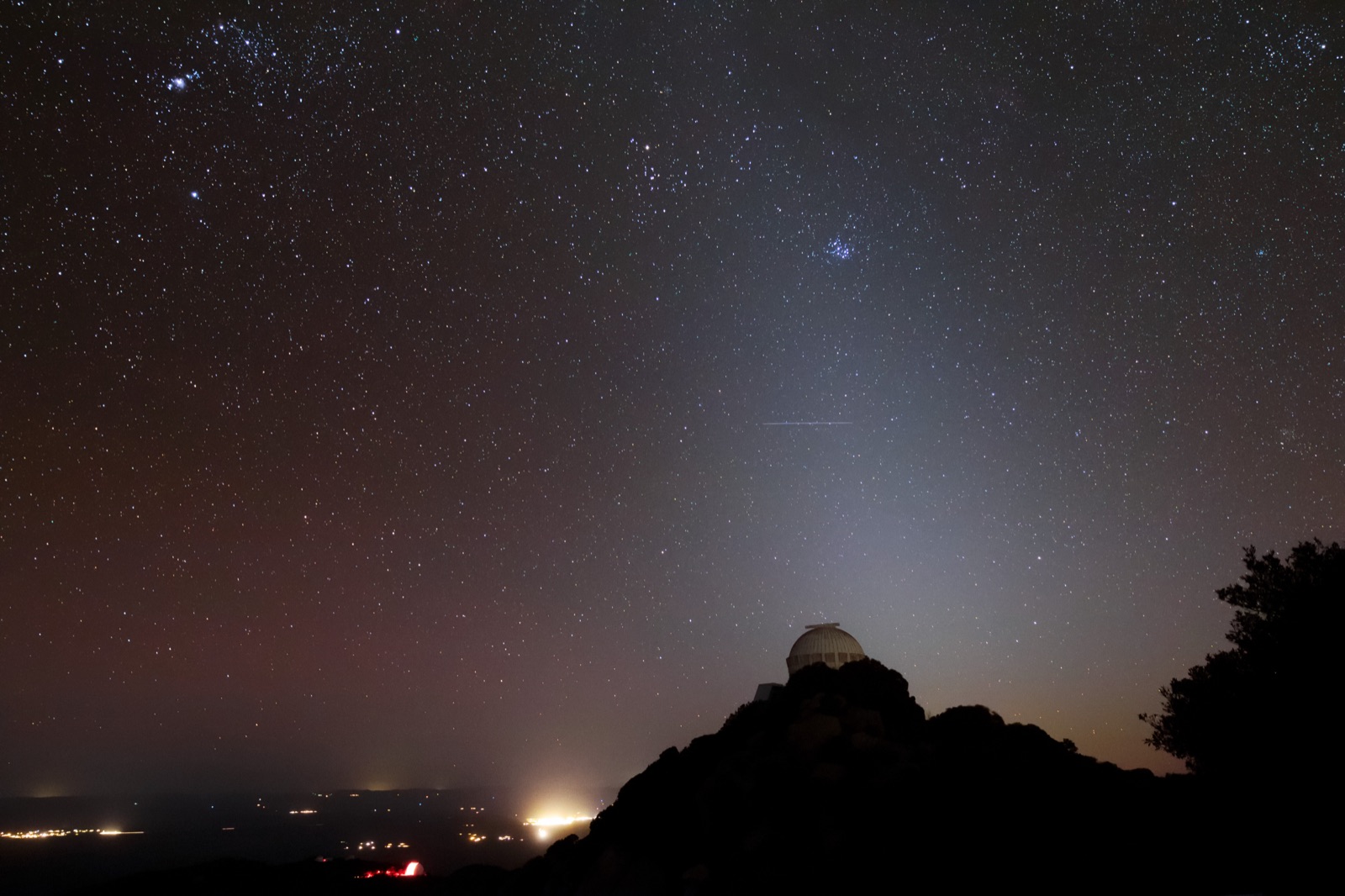
Direction matters as well as distance. Skyglow is a dome centred on the city. It's brightest low in that direction and fades higher up. So put the city behind you and pick a site whose darkest horizon faces the target. For the Milky Way core in the northern hemisphere, that means a dark southern horizon. In the southern hemisphere the core passes overhead, so the whole sky matters. Hills help in two ways. They block the direct glow and they put you above the haze that scatters it. A ridge between you and the nearest town can improve the sky by a full class.
The Moon is the biggest light polluter of all
Everything above assumes a Moon-free sky. A full Moon lifts the zenith to about 18 mag/arcsec² (measured at Flagstaff, one of the best-protected observing sites in the United States), which is the range of a Bortle 7 sky. It does this everywhere, including the darkest desert on Earth. A first-quarter Moon gives about a tenth of that light, which is still enough to hide the fainter half of the Milky Way and turn a class 2 site into a class 4–5 one until it sets.
You don't need a new Moon. You need the Moon below the horizon while the target is up. A waning Moon rises late, so the evening is dark. A waxing crescent sets early. That gives a good site two dark weeks a month, not one (see Moon phases for photographers).
Still Dark ranks the best Milky Way nights for your location by the length of the Moon-free dark window, the hours between astronomical dusk and dawn with the Moon below the horizon, and by where the core sits in the sky. The Sun & Moon card gives Moon rise and set, phase and % illuminated for any date. Sky Events lists the new Moons, meteor showers and conjunctions that fall on dark nights.
Airglow, and the LED problem
Even a class 1 sky isn't black. Airglow comes from oxygen and sodium atoms high in the atmosphere, which absorb sunlight by day and release it at night. It accounts for most of the natural sky brightness of about 22 mag/arcsec² at the zenith. In long exposures it shows as faint green or red bands, often rippled, strongest near the horizon, and it varies by half a magnitude or more from night to night. That's why one site reads class 1 in one report and class 2 in another. Airglow moves and changes colour over an hour, but a town's dome stays where it is.
Light pollution is changing colour too. Sodium street lamps put most of their light in a narrow yellow-orange band that a filter could cut while passing the rest of the spectrum. White LEDs emit across the whole visible band, with more of the blue that scatters most in air. The old broadband "city light suppression" filters help much less under LED lighting. Narrowband filters still work for emission nebulae, but no filter can separate a broadband target like the Milky Way from a broadband sky.
What to photograph from a Bortle 7–8 city sky
A city sky hides the faint targets but not the bright ones:
- The Moon in every phase, especially the terminator at first and last quarter, and the Moon rising behind a landmark.
- The planets. Skyglow doesn't affect Jupiter, Saturn, Mars and Venus. A telescope in the city does as well on them as one in the desert, if the seeing is good. See how to photograph the planets.
- Conjunctions of the Moon and planets, which you shoot in twilight anyway. See photographing a conjunction.
- Star trails, which work in a bright sky if the frames are short, because the trails build up and the background doesn't. See star trails.
- The ISS and other bright satellites, which are brighter than everything except the Moon. See photographing the ISS.
Still Dark Weather shows cloud in three layers, low, mid and high, hour by hour. High cirrus matters more than you'd expect. It can be thin enough that you still see stars, but it scatters city light back down across the whole sky and can turn a class 4 night into a class 6 one. Pick a night when the high layer is clear.
Dark sky site checklist
- Dark toward the target. Check the map in the direction you'll shoot, not just at the pin.
- High, or at least not in a valley. Valleys hold haze and collect the glow of the towns around them.
- Dry. Humid air scatters light, so a class 3 site in the desert is better than a class 3 site on the coast.
- Safe. Off the road, out of headlight sweep, on ground you've seen in daylight.
- Legal. Public land, an open park, or permission.
- An open horizon where you need it. If the core is the target, that means no ridge or tree line to the south.
- Cell signal optional. Download offline maps and set up the plan before you lose coverage.

Common mistakes
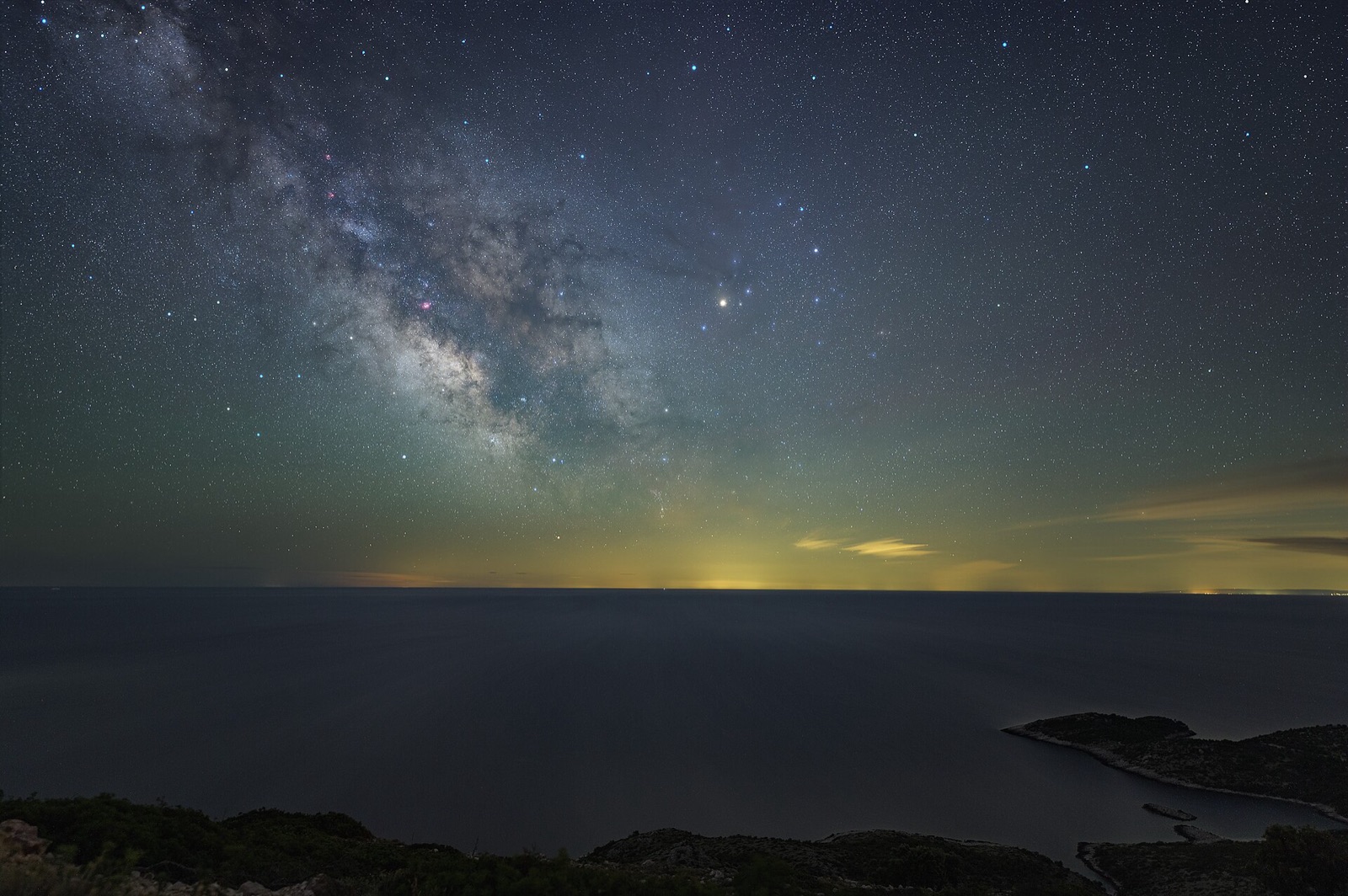
- Trusting the map pin without checking the horizon toward the target. A class 3 pixel with a city to its south is a class 5 site for the Milky Way.
- Driving two hours under a gibbous Moon. Check Moon rise and set before you check the weather.
- Grading the sky by the bright stars. Orion looks fine from anywhere. Use the faint stars to test.
- Expecting a filter to fix a city Milky Way. Under LED lighting it won't.
FAQ
What Bortle class do you need to see the Milky Way?
On the Bortle scale, class 4 or better shows a structured band with dark lanes. Class 5 shows the core faintly, and class 6 shows a smudge overhead at best. A camera records more from a class 5 sky than your eye does, but the gradient takes over the lower part of the frame.
Do light pollution filters help with the Milky Way?
Less each year. Filters cut the narrow emission of sodium lamps, but LED street lighting is broadband and white, so there's nothing narrow to cut. Narrowband filters still work for emission nebulae. For the Milky Way, the only things that help are getting away from the city and shooting when the Moon is down.
How to tell airglow from light pollution in a photo
Airglow is green or red, banded or rippled, appears in every direction and changes over the night. Light pollution is orange, yellow or white, fixed on the horizon toward a town, and brightest low down.
Why does a cloud look bright in the city and black in the countryside?
A cloud reflects whatever shines on it. Over a city that's street light, so the cloud glows brighter than the sky. Under a dark sky nothing lights it from below, so it hides the stars and shows as a black gap. It's the quickest single test of a site.
Sources and further reading
- Sky & Telescope — Gauging Light Pollution: The Bortle Dark-Sky Scale (John Bortle's February 2001 article: the nine classes, limiting magnitudes and criteria).
- Wikipedia — Bortle scale (approximate mag/arcsec² equivalents per class).
- Falchi et al., Science Advances 2016 — The new world atlas of artificial night sky brightness (80% of the world and 99% of the US and Europe under polluted skies; Milky Way hidden from a third of humanity; VIIRS and SQM methodology).
- DarkSky International — 250 International Dark Sky Places (the certification programme and its count as of November 2025).
- NASA — How to Find Good Places to Stargaze (20–30 miles from city limits; site-selection advice).
- Jerry Lodriguss, Astropix — The Brightness of the Night Sky (22 mag/arcsec² natural sky; ≈18 mag/arcsec² at full Moon).