Planets
How to Photograph the Planets: Jupiter, Saturn and Mars From a Backyard
Light pollution doesn't matter for planets. You can photograph Jupiter and Saturn from a city balcony, and the technique that gets belts and rings out of a shaky telescope image was developed by amateurs with small scopes. The timing matters, though. An outer planet is worth the effort for a few months around opposition, and Mars for a few weeks every two years. This guide covers how to photograph planets in 2026–2027: when the oppositions are, the two kinds of planet photo, and what each level of equipment will show. With some equipment that's less than you'd hope, and with some it's more.
At a glance
- When: the months around opposition. Saturn 4 Oct 2026 and 18 Oct 2027, Neptune 26 Sep 2026, Uranus 25 Nov 2026, Jupiter 11 Feb 2027, Mars 19 Feb 2027.
- Planet in a landscape: 24–50 mm, f/2.8–f/5.6, 1/30 s to 10 s, ISO 100–1600 depending on twilight. A Moon–planet pairing in civil twilight is the easiest picture in astrophotography.
- Planet as a disc: a telescope at ≥ 1,000 mm effective focal length, video at 30–100 fps for 1–3 minutes, stack the sharpest 10–30 % of frames, sharpen with wavelets.
- Where in the sky: above 30–40° altitude, after the ground has cooled, on a night when the air is steady and not just clear.
- Afterwards: AutoStakkert! to stack, RegiStax or AstroSurface to sharpen. The finished photograph is the stack, not any single frame.
What opposition means, and why it's the date to plan around
An outer planet is at opposition when Earth passes between it and the Sun, so the planet sits opposite the Sun in our sky. Four things happen at the same time, and all of them help. The planet is at (or within a day of) its closest for the year, so its disc is largest. It's fully lit and brightest. It rises at sunset and sets at sunrise, so it's up all night. And it crosses the meridian, its highest point, around local midnight. The weeks either side are nearly as good, and since the planet transits four minutes earlier each night, six weeks later it's high by mid-evening, so you don't have to stay up as late.
Oppositions repeat at the planet's synodic period. For Jupiter that's about 399 days, so every 13 months and a month later each year. For Mars it's about 780 days, so every 26 months. For Saturn, Uranus and Neptune it's a few days over a year, so their oppositions come about two weeks later each year.
Planet opposition dates for 2026 and 2027
| Planet | Opposition (UTC) | Magnitude | Apparent diameter | Distance | Notes |
|---|---|---|---|---|---|
| Neptune | 26 Sep 2026, 02 h | +7.8 | 2.4″ | 28.9 AU | Pisces. Visible in binoculars |
| Saturn | 4 Oct 2026 | +0.3 | 19.7″ | 8.43 AU | Rings tilted only ~7° |
| Uranus | 25 Nov 2026, 23 h | +5.6 | 3.8″ | 18.4 AU | Taurus, near the Pleiades |
| Jupiter | 11 Feb 2027, 00:21 | −2.5 | 44.2″ | 4.36 AU | Leo. Evening of 10 Feb in the Americas |
| Mars | 19 Feb 2027 | −1.2 | 13.8″ | 0.68 AU | Aphelic opposition, so Mars is small and distant |
| Neptune | 28 Sep 2027 | ≈ +7.8 | ≈ 2.4″ | ≈ 28.9 AU | Barely changes year to year |
| Saturn | 18 Oct 2027 | +0.1 | 20.0″ | 8.33 AU | Rings opened to ~12° |
| Uranus | 30 Nov 2027 | +5.6 | 3.8″ | 18.38 AU | Taurus |
Jupiter's 2026 opposition has already happened. It was on 10 January 2026, and the next is 11 February 2027, because Jupiter's oppositions come about 13 months apart.
Still Dark lists every opposition and Mercury elongation with the exact time for your zone under Sky Events → Oppositions, with the planet's magnitude and apparent diameter on that date, and a reminder. The Solar System card's time machine shows why the dates fall where they do. Scrub forward and watch Earth lap Jupiter every 13 months and Mars every 26, and see how far Mars sits from Earth at the 2027 line-up compared with a close opposition.
How to photograph planets: two kinds of picture
The first is the planet as a point. You use a wide or normal lens, put a landscape or the Moon in the frame, and shoot in twilight for the colour. Any camera will do, even a phone. The planet shows up as a bright star, which is what it looks like to the eye.
The second is the planet as a disc. This needs a telescope, a high-frame-rate camera, video, stacking and sharpening. The limit is image scale, because Jupiter at 44″ is only about 1/40 the width of the Moon.
Photographing a planet in a landscape
The best pictures of this kind are made in twilight, when the sky still has colour and the planet has only just become visible. Jupiter and Venus appear in civil twilight, Saturn and Mars in nautical twilight. A crescent Moon nearby makes a better composition. The Moon passes each planet about once a month, so there's usually a pairing coming up (our conjunction guide has the dates).

| Scene | Lens | Aperture | Shutter | ISO | Notes |
|---|---|---|---|---|---|
| Moon + planet, civil twilight | 35–85 mm | f/4–f/5.6 | 1/60–1/4 s | 100–400 | Expose for the sky. The Moon may clip slightly |
| Planet over skyline, nautical twilight | 24–50 mm | f/2.8–f/4 | 1–4 s | 400–800 | Tripod, 2 s timer, manual focus on the planet |
| Planet in a dark landscape | 14–35 mm | f/2.8 | 8–15 s | 1600–3200 | Stars begin to trail past ~10 s at 24 mm |
| Moon–planet close pairing | 200–400 mm | f/5.6–f/8 | 1/125–1/30 s | 200–800 | Bracket. Blend in a short Moon frame if it clips |
Focus by magnifying live view on the planet itself, which is the sharpest point in the sky. Shoot RAW, because twilight gradients show banding in JPEG first. With a phone, tap the planet to set focus and exposure, lock them, and use a small tripod and the timer.
Photographing the disc: lucky imaging through a telescope
The air is always moving. A long exposure averages seconds of turbulence into a blur. Video at 30–100 frames per second catches the moments when the air is steady, and stacking only those frames gives an image much sharper than any single frame. That's how to photograph planets as discs, and you can do it from a back garden.


- Get the image scale right. Aim for a focal ratio of about 5× your camera's pixel size in microns (explained below). With a 6–8″ scope this usually means a 2× or 2.5× Barlow.
- Focus on the planet's limb or a moon, and refocus as the tube cools, because the focus shifts.
- Record video with a planetary camera or a mirrorless body in crop-video mode: 30–100 fps, histogram peaking at 60–70 %, moderate gain, SER or uncompressed AVI.
- Keep clips short. Use 1–2 minutes for Jupiter, 3 at most, and 4–5 minutes for Mars and Saturn. Past that, Jupiter's rotation blurs fine detail.
- Stack in AutoStakkert!, which grades every frame and keeps the best 10–30 %. Keep fewer in poor seeing and more in good seeing.
- Sharpen with wavelets in RegiStax or AstroSurface. Stop before the limb gets a bright rim or the background fills with grain, then back off one more notch. Most people over-sharpen their first Jupiter.
Phone through an eyepiece. A smartphone clamped to a 10–25 mm eyepiece with an adapter can do all of this on Jupiter and Saturn. Lock focus and exposure, record 4K video for 60–90 s, then put the clip through the same stacking software. On a steady night it shows Jupiter's main belts and Saturn's rings.
Seeing, altitude and timing
"Seeing" is the steadiness of the air, and for planets it matters much more than transparency. A hazy, humid, windless night often has very good seeing. A very clear night behind a cold front usually has bad seeing, even though it looks perfect from indoors.
- Altitude above 30–40°. At 20° you look through nearly three times as much air as at the zenith, and atmospheric dispersion smears the planet into colour fringes. Waiting until the planet is high is the biggest improvement you can make from a backyard.
- Wait for the ground to cool. Roofs and paving release heat for an hour or two after dark, straight up your line of sight. Grass is better than concrete, and the hours before dawn are often the calmest.
- Cool the telescope. A scope carried out of a warm room is warmer than the night air, and the warm air inside it blurs the image. Set it out 30–60 minutes early.
In the 360° sky, search the planet and drag time forward through the night to watch its altitude climb, find its transit time and see when it clears your roofline. Rise, transit and set are listed with the magnitude. Weather gives hourly seeing and transparency conditions with cloud split into low, mid and high layers. Thin high cloud that would ruin a Milky Way shot is often harmless for a bright planet, while a clear but unsteady hour is not.
Focal length, Barlows and the f/ratio rule
To show detail on a disc a few tens of arcseconds wide you need at least 1,000 mm of effective focal length, and usually 2,000–4,000 mm. A Barlow lens is the usual way to get there. It's a negative lens that multiplies the telescope's focal length by 2×, 2.5× or 3× without changing its aperture, so the focal ratio multiplies by the same factor.
.jpg)
To decide how much to multiply, use this rule: target focal ratio ≈ 5 × pixel size in microns. A camera with 3.75 µm pixels needs about f/19, and one with 2.9 µm pixels needs about f/15. On excellent nights you can go up to 7×. In average seeing 3–4× gives a brighter image with shorter exposures, and you don't lose any detail, because the air wouldn't have let you record it. An 8″ f/10 Schmidt–Cassegrain with a 2× Barlow sits at f/20 and 4,000 mm, right for 3.75 µm pixels, while a 6″ f/8 Newtonian needs a 2.5× for the same sampling.
Planet by planet: what to look for
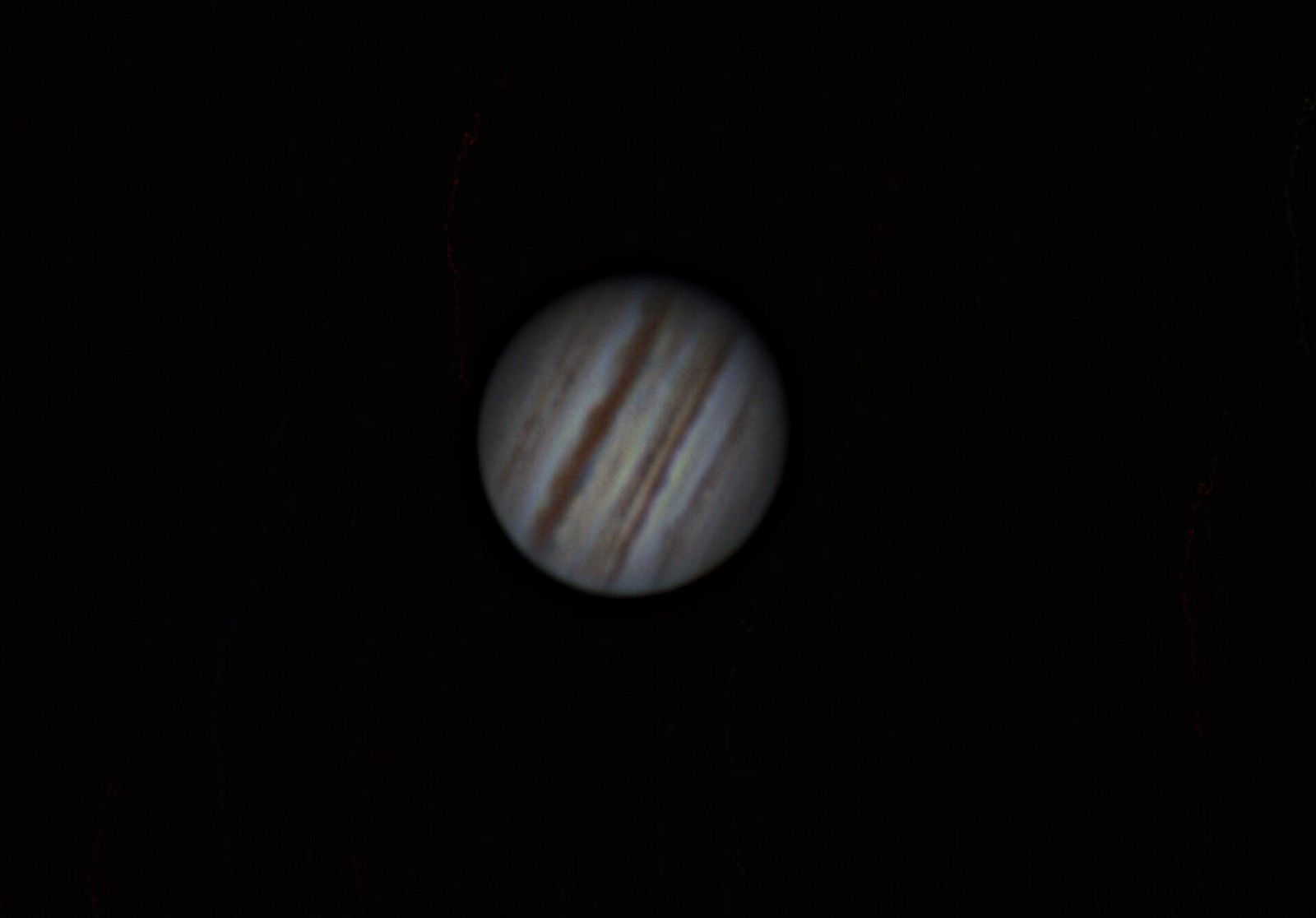
Jupiter. Jupiter shows more detail than any other planet: two dark equatorial belts, finer belts and zones, festoons, and the Great Red Spot, an anticyclone about twice Earth's width that has been observed for more than 300 years. Jupiter spins once in under ten hours (9 h 56 min at the poles, 9 h 50 min at the equator), so the Spot faces Earth only about half the time and you can see features move in minutes. That rotation is why clips are limited to two or three minutes. Any binoculars show the four Galilean moons, and their positions change every night.
Saturn. The rings crossed edge-on in March 2025 and are reopening slowly. The tilt is about 7° at the October 2026 opposition and about 12° at the October 2027 one, and it widens to its near-maximum of 27° by 2032. Narrow rings have some advantages. The globe's shadow on the rings and the ring shadow on the globe stand out, and the moons are easier to see without the glare. The Cassini Division needs a steady night and at least 4″ of aperture.
Mars. Mars shows a disc with detail for two or three months around each opposition. The rest of the time it's a featureless orange point 4–6″ across. The 19 February 2027 opposition is an aphelic one, with Mars near the far end of its orbit, so the disc is only 13.8″ across at magnitude −1.2. It is high in the sky for northern observers, which helps. Look for the north polar cap and dark markings such as Syrtis Major.
Uranus and Neptune. Both are discs, 3.8″ and 2.4″, and a 6–8″ scope at high power shows them as small pale-green and blue-grey balls with no detail. That's all there is to photograph. Uranus at magnitude 5.6 can be seen with the naked eye from a dark site, and Neptune at 7.8 needs binoculars.
Mercury. Mercury is never far from the Sun, so it's a hard twilight subject for a landscape photo. It's best at greatest elongation, when it's 18–28° from the Sun and visible for under an hour after sunset or before dawn. As a disc it's always low and in poor seeing. Check Sky Events → Elongations for the next apparition.
Gear tiers: what each telescope will show
| Tier | Jupiter | Saturn | Mars | Phone tip |
|---|---|---|---|---|
| Binoculars 7×–10× | Tiny disc, four Galilean moons in a line | Slightly oval star. Titan at 10× | Orange point | Binocular adapter. 1/15 s, ISO 400 for the moons |
| 80 mm refractor | Two main belts, moon shadows, the Spot when it faces us | Rings clearly separate from the globe. Cassini Division in steady air | Polar cap, a dark marking or two near opposition | Eyepiece adapter on a 12–20 mm eyepiece. 60 s of 4K video, exposure locked |
| 6–8″ reflector or SCT | Multiple belts, festoons, Spot detail, moon transits | Cassini Division, ring shadows, banding, 3–4 moons | Cap, clouds, named albedo features | Same, or a planetary camera with a 2× Barlow at f/15–f/20 |
| 10″+ SCT or Dobsonian | Fine belt structure, barges, oval storms | Encke Gap in excellent seeing, faint inner ring | Small albedo detail, limb clouds | Seeing limits you more than the phone does. Add a dispersion corrector |
More aperture only gives more resolution when the air is steady. On an average night a well-collimated 6″ shows as much as the seeing allows, and a 12″ only does better on the rare steady night. Check a reflector's collimation on a star before every session, even though it's tedious. It makes a big difference to sharpness.
Common mistakes
- Shooting the planet low because it's convenient at 9 p.m. Wait, or come back after midnight in the weeks before opposition.
- Single still frames of the disc. Above 1,000 mm you need video and stacking.
- Over-long clips on Jupiter. Three minutes is the limit unless you use derotation software.
- Over-sharpening. A bright rim on the limb and "onion rings" in the belts mean the wavelets went too far.
- Too much focal length in poor seeing. Take the Barlow off when the planet's image is shimmering badly.
- Expecting Mars to look good in 2026. It won't look good until early 2027.
FAQ
When is the best time to photograph the planets in 2026 and 2027?
Around opposition: Saturn on 4 October 2026 and 18 October 2027, Neptune on 26 September 2026 and 28 September 2027, Uranus on 25 November 2026 and 30 November 2027, Jupiter on 11 February 2027 (the 2026 one was on 10 January), and Mars on 19 February 2027.
Can I photograph Jupiter's Great Red Spot with a small telescope?
With an 80–100 mm telescope, video stacking and good seeing, yes, as a pale oval notch in the south equatorial belt. It faces Earth only about half of any night, so use a Red Spot transit predictor for the timing.
Why do my planet photos look like blurry blobs?
The cause is usually seeing, altitude, or a warm telescope, in that order. A single frame through turbulent air can't be sharp, so record video and stack, shoot when the planet is above 30–40°, and let the scope cool.
Are Saturn's rings visible in 2026?
Yes, but narrow. After the March 2025 edge-on crossing the tilt is only about 7° at the October 2026 opposition, opening to roughly 12° by October 2027 and widening until 2032. The rings are obvious in any telescope, but the Cassini Division is harder to see than usual.
Can you photograph planets with a phone?
Yes. As a point in a twilight landscape it's easy. Lock focus and exposure on the planet and use a tripod. As a disc, you can only do it through a telescope eyepiece with an adapter. Record video with exposure locked and stack the clip as you would from any camera.
Sources and further reading
- In-The-Sky.org — Mars at opposition, 19 February 2027 (0.68 AU, 13.8″, magnitude −1.2; companion pages give Saturn, Uranus and Neptune's 2026–27 distance, diameter and ring tilt).
- EarthSky — Jupiter at opposition (11 Feb 2027 at 0:21 UTC, magnitude −2.5, Leo, the 13-month cycle).
- In-The-Sky.org — Saturn at opposition, 4 October 2026 (8.43 AU, 19.7″, magnitude 0.3, rings at 7°).
- NASA Science — Jupiter facts (a 9.9-hour day, the Great Red Spot twice Earth's width and observed for 300+ years, the Galilean moons).
- Jerry Lodriguss, Astropix — High-Resolution Planetary Imaging (the 3×–7× pixel-size focal-ratio rule, clip lengths per planet, stacking the best frames, why altitude matters).
- Sea and Sky — Astronomy Calendar of Celestial Events 2027 (opposition and Mercury elongation dates for 2027).