Conjunctions
How to Photograph a Conjunction: the Moon and Venus, Planet Pairings and Close Approaches
A conjunction is two bright things close together in the sky: a crescent Moon beside Venus in the evening twilight, Jupiter and Mars a finger-width apart before dawn, or the Moon passing in front of a planet. A Moon and Venus conjunction is about the easiest thing in the night sky to photograph. You don't need a dark sky, a tracker or a long drive. It's still hard to get exactly right, because the two objects are rarely the same brightness and the best light lasts about twenty minutes.
At a glance
- Settings, twilight wide shot: f/4–5.6, 1/15–2 s, ISO 200–800, tripod, manual focus on the planet. Expose for the sky and let the Moon's lit limb clip a little.
- Settings, telephoto crescent: 1/125 s at f/8, ISO 200 for the sunlit limb, and 1–4 s at f/5.6, ISO 800 for earthshine and the planet. Bracket and blend.
- When: 20–60 minutes after sunset for evening pairings, and the same window before sunrise for morning ones.
- Where to look: evening pairings are in the west after sunset, morning pairings in the east before dawn. A fist at arm's length is 10° and the full Moon is 0.5°.
- Afterwards: merge the short and long frames so the crescent, the earthshine and the planet all show detail.
What a conjunction is, and how close is close
Strictly, two objects are in conjunction when they have the same right ascension (the same celestial longitude), so one is due north or south of the other on the sky's grid. Some almanacs use ecliptic longitude instead, which can change the time by hours. Neither is exactly the moment the two look closest, which is called the appulse or closest approach. None of this matters much for a photograph. The pairing looks good for an evening either side, and the number you need is the separation.
Separation is measured in degrees, and you can measure it with your hand. A fist at arm's length covers about 10° of sky, three middle fingers cover 5°, and the tip of a little finger covers about 1°. The full Moon is only half a degree across, so a "close" conjunction of 1° is two Moon-widths, and a very close one of 0.3° is a gap narrower than the Moon itself. A degree is 60 arcminutes (′), and an arcminute is 60 arcseconds (″).
The Moon goes around the whole sky in 27.3 days. It moves eastward about 13° a day, which is its own width every hour. The planets move much more slowly, so each month the Moon passes every planet that's up at night. That's why "Moon and Venus tonight" comes around about once a month while Venus is visible, and why the Moon–Jupiter conjunctions of late 2026 and early 2027 come every 27–28 days.
Which pairings are worth photographing
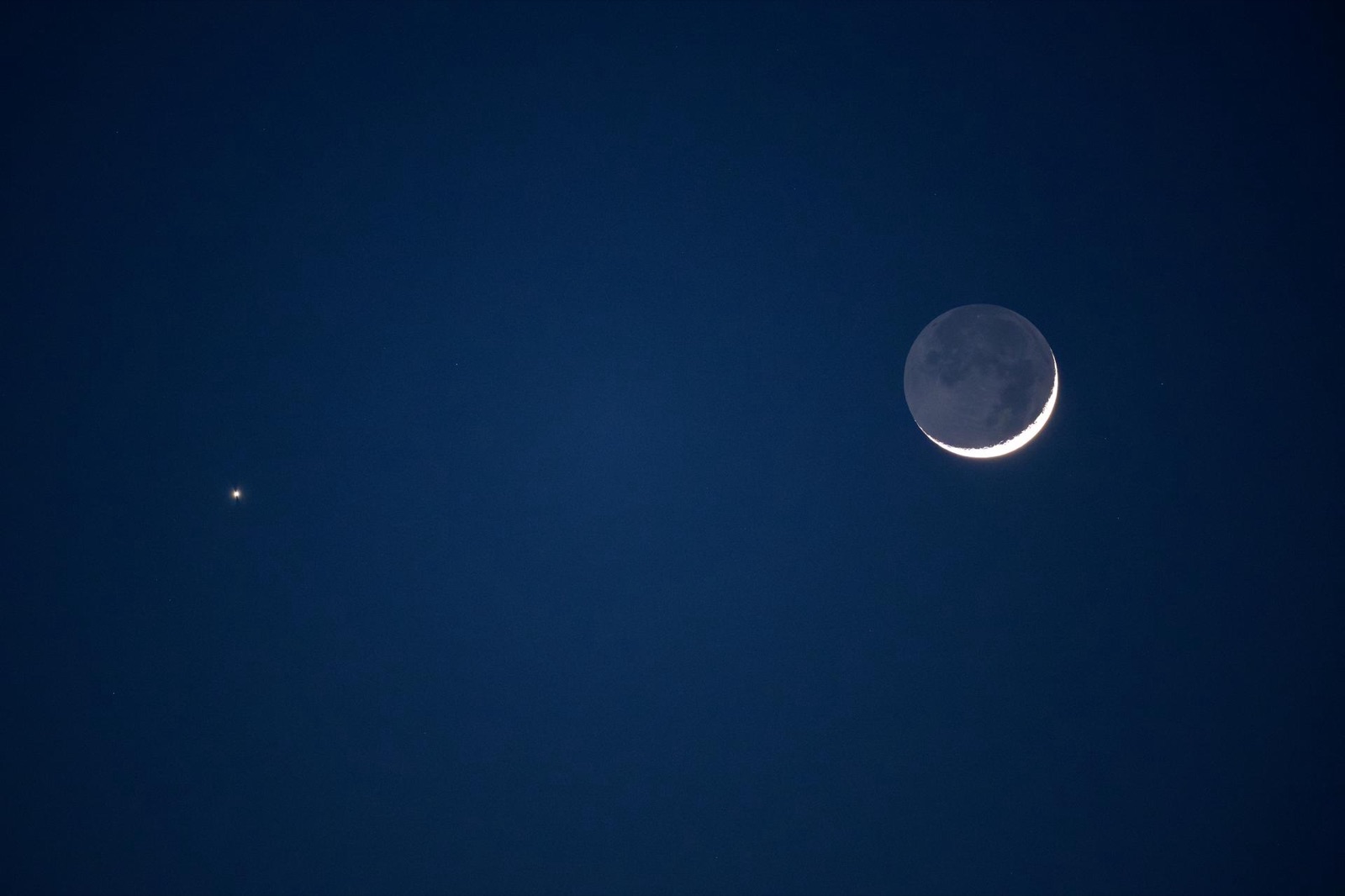
- A young crescent (1–4 days old) beside Venus or Jupiter in evening twilight. The sky is still blue, there's colour on the horizon, and the Moon's night side glows with earthshine. Earthshine is sunlight reflected off a nearly full Earth, and it's easiest to see in the days either side of new Moon. The old crescent before dawn gives you the same scene in the morning.
- A crescent within a degree or two of a planet, close enough for a 200–400 mm lens to fit both in the frame.
- Planet–planet meetings. Venus and Jupiter, the two brightest planets, pass each other about once a year, though some of these pairings happen too close to the Sun to see. The June 8–9, 2026 pairing in the western evening sky was a good one, but the 2027 one is lost in the Sun's glare. Venus passes Mars or Saturn whenever its path through the twilight takes it past the slower planet. Both objects are points of similar brightness, so one exposure is enough.
- Occultations, where the Moon covers a planet or bright star (more below).
A gibbous or full Moon beside a planet doesn't photograph as well. The Moon is so bright that in most exposures you get a white disc and a dot.
Conjunction dates for 2026 and 2027, and how to find them
Still Dark lists Moon–planet and planet–planet conjunctions and close approaches in Sky Events → Conjunctions: the time of closest approach, the separation in degrees, and the altitude and direction of the pair at dusk or dawn for your location, which tells you whether it clears your horizon. Tap an event to open it in the 360° sky and drag the time forward and back to watch the Moon move past the planet. Set a reminder for the night before.
Check the altitude as well as the separation. Below 5° the pair is lost in haze, and 10–20° is high enough. A 3° pairing at 15° with a two-day-old crescent makes a better photograph than a 0.5° one that sets before the sky gets dark.
The dates below are from Fred Espenak's Astropixels almanac (geocentric, UT), with the separation at the moment of conjunction. Where an occultation is marked, the Moon covers the object for some part of the world. The app works out which part, and the local time of closest approach, for your coordinates. The monthly Moon–Saturn and Moon–Mars passes aren't listed here but are in the app.
| Date (UT) | Pairing | Separation | Notes |
|---|---|---|---|
| 2026 Sep 14 | Moon and Venus | 0.5° | Occultation. In daylight for Europe and the Middle East, at dusk for south-east Asia. |
| 2026 Oct 6 | Moon and Jupiter | 0.2° | Occultation visible from the contiguous United States. |
| 2026 Nov 2 | Moon, Mars and Jupiter | 1.1° and 0.5° | The Moon occults both, hours apart. All three fit in one morning frame. |
| 2026 Nov 7 | Moon and Venus | 1.1° | Old crescent and Venus before dawn. The occultation itself is over the south-east Pacific. |
| 2026 Nov 14–16 | Mars and Jupiter | 1.2° | Morning sky. Closest approach a day or two before the Nov 16 conjunction. |
| 2027 Feb 20 | Moon and Jupiter | 1.2° | Occultation, with a bright gibbous Moon. More Jupiter occultations Mar 19 and Apr 15. |
| 2027 Mar 4 | Moon and Venus | 2.1° | Morning crescent with Venus in the east. |
| 2027 May 7 | Venus and Saturn | 0.6° | Morning twilight, low in the east. |
| 2027 Nov 25 | Venus and Mars | 0.3° | Evening twilight, low in the west. Mars is faint. |
| 2027 Nov 30 | Moon and Venus | 0.9° | Occultation for part of the world. |
| 2027 Dec 29 | Moon and Mars | 0.5° | Occultation for part of the world. |
Venus passes inferior conjunction on Oct 24, 2026, is a morning object through the first half of 2027, and returns to the evening sky after superior conjunction on Aug 11, 2027. So every 2027 Moon and Venus conjunction is a morning event until autumn. Our guide to why Venus is so bright explains the whole cycle.
The twilight window, and camera settings by scene
A crescent and a planet together cover about ten stops of brightness. The sunlit limb is as bright as a sunlit landscape, Venus at magnitude −4 shows up in almost any exposure, and the earthshine is thousands of times fainter than the limb. You can't get all three in one frame, so pick the one that matters most to you and bracket for the others.
Good timing helps a lot. With the Sun 3–8° below the horizon, about 20 to 60 minutes after sunset at mid-latitudes, the sky is dark enough to show the earthshine but still bright enough to balance the crescent, and there's still some colour on the horizon (see our twilight guide for the stages). Fifteen minutes later the sky is black, the crescent overexposes and the pair is dropping into the haze. For morning pairings the window runs the other way, so get there early and be set up before the sky starts to lighten.
- Twilight wide shot (14–50 mm) over a landscape. Manual, RAW, tripod. f/4–5.6, ISO 200–800, shutter from 1/15 s in bright twilight to 2 s as the sky gets darker. Expose for the sky. The crescent will clip a little and Venus will be a sharp point. White balance 4000–5000 K.
- Telephoto crescent (200–600 mm). For the lit limb: 1/125 s, f/8, ISO 200, which is a daylight exposure. Check the histogram, since a thin crescent is dimmer per unit area than a full Moon. For the earthshine and the planet: 1–4 s at f/5.6, ISO 800. Bracket in whole stops from 1/250 s to 4 s and blend later. HDR makes sense here, because your eye does see all three brightnesses at once.
- Planet–planet pair. One exposure: f/4–5.6, 1–4 s, ISO 400–1600 depending on the twilight. Make it long enough to show the fainter planet clearly and short enough that it doesn't trail. The sky moves 15″ a second, so at 200 mm keep it under about 2 s, at 400 mm under 1 s.
- Phone. Tap the Moon to set exposure and drag the slider down until the crescent stops glowing. Night mode works for the wide twilight scene but not for the Moon itself. Brace the phone, use the optical telephoto and not digital zoom, and shoot RAW if your phone has it.
Which focal length fills the frame
The table shows how much of a full-frame sensor's long side a given separation takes up. Between about 20% and 60% works best. The two objects are clearly a pair, and there's room for a horizon or the earthshine. Under 5% you get two dots. Over 85% the pair may not fit once you allow for the size of the objects themselves. On APS-C multiply by 1.5. On a phone's main camera (about 24 mm equivalent) use the 24 mm row.
| Focal length (full frame) | Field, long × short side | 0.5° | 1° | 3° | 5° | 10° |
|---|---|---|---|---|---|---|
| 24 mm | 74° × 53° | 0.7% | 1.4% | 4% | 7% | 14% |
| 50 mm | 40° × 27° | 1.3% | 2.5% | 8% | 13% | 25% |
| 85 mm | 24° × 16° | 2% | 4% | 13% | 21% | 42% |
| 135 mm | 15° × 10° | 3% | 7% | 20% | 33% | 66% |
| 200 mm | 10.3° × 6.9° | 5% | 10% | 29% | 49% | too tight |
| 400 mm | 5.2° × 3.4° | 10% | 19% | 58% | too tight | won't fit |
| 600 mm | 3.4° × 2.3° | 15% | 29% | 87% | won't fit | won't fit |
Putting the pairing over a landmark
Evening conjunctions are in the west after sunset and get lower as you watch. Morning ones rise in the east before dawn. In the northern hemisphere they move towards the south-west or south-east in autumn and winter and towards the north-west or north-east in spring and summer, because the ecliptic tilts with the seasons. Get the exact azimuth for your date, then find a spot where that bearing lines up with something worth photographing (a headland, a tower, a ridge) at the altitude the pair will have in the middle of the window.
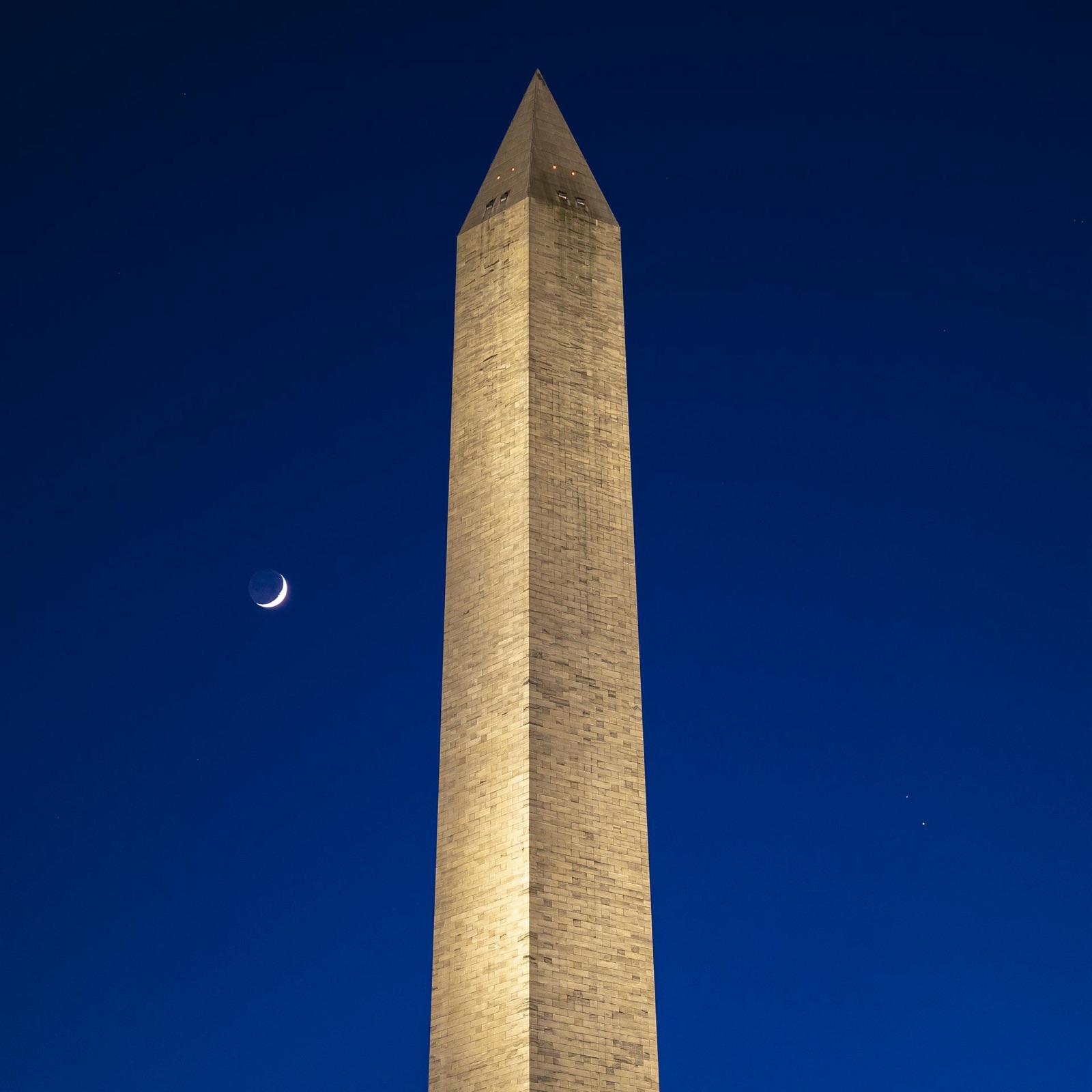
In the Planner, set the date and time of the conjunction and the map draws the Moon's direction line from wherever you stand. Enter your focal length and sensor and the camera field-of-view overlay shows how much of the landscape fits in the frame. The "stand here" alignment shows where to put the tripod so the pairing sits over your chosen landmark, and the altitude curves on the timeline show how long you have before it drops into the haze.
Arrive half an hour early. Focus on the planet at 100% magnification while it's the only thing visible, then shoot every couple of minutes through the window. The balance between sky, crescent and earthshine changes quickly, and the best frame often isn't the one you expected while you were shooting.
Lunar occultations: when the Moon covers a planet
Every month or two the Moon's path takes it directly across a bright star or planet, and from a band of Earth a few thousand miles wide the object vanishes behind one limb and reappears from the other up to an hour later. The Moon has no atmosphere, so a star disappears instantly, while a planet takes a few seconds as its disc is covered. Bright stars near the ecliptic (Antares, Regulus, Aldebaran, Spica, the Pleiades) are occulted in runs lasting a year or two. In late 2026 there is a series of Jupiter occultations, and on Oct 6 the Moon covers Jupiter for observers across the contiguous United States. Whether you can see it, and whether it happens in darkness, depends on where you are. A few hundred miles away the same event is only a close pass, so check the app for your own coordinates and don't rely on a world date.
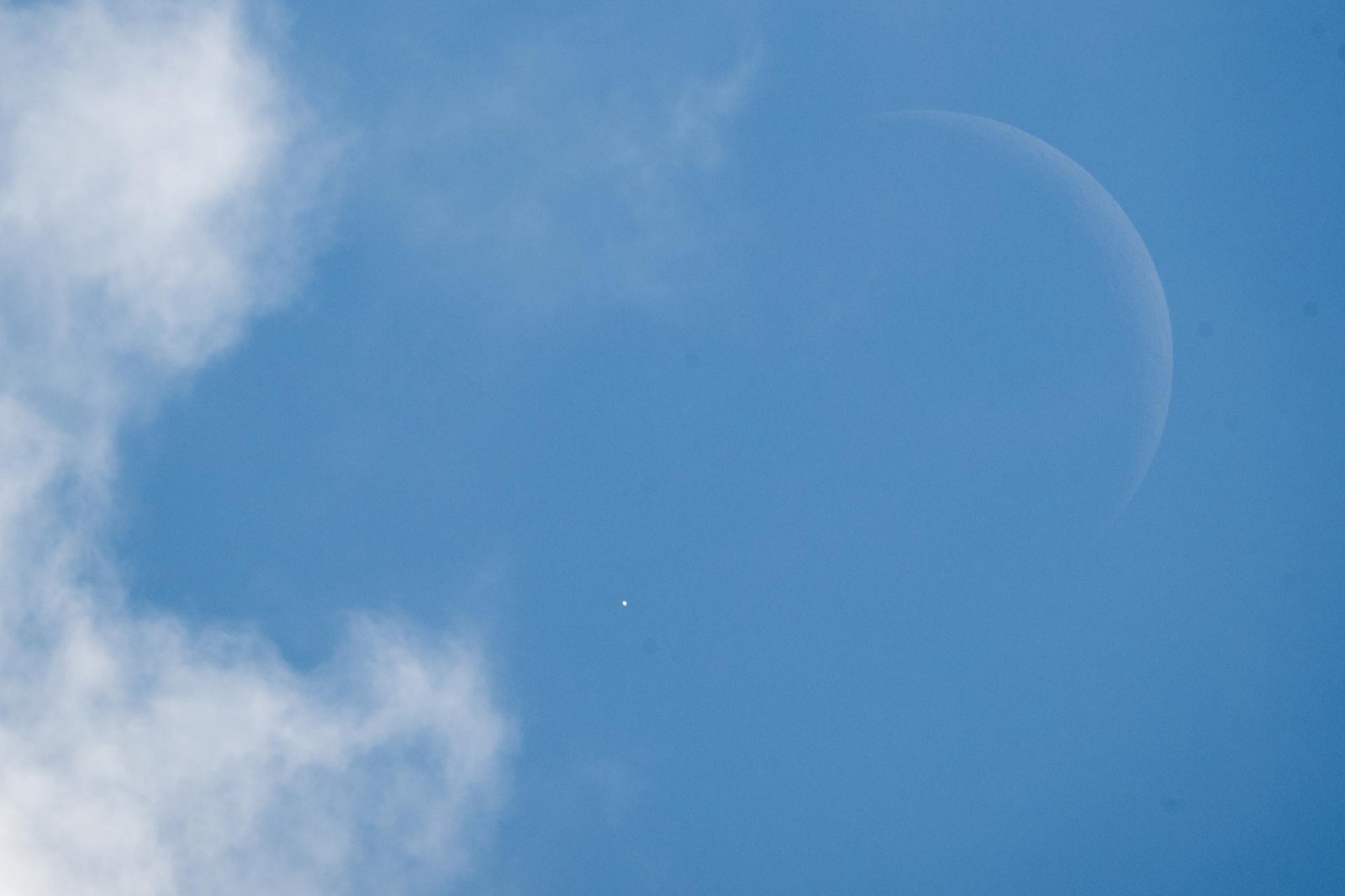
The best moment to photograph is the disappearance or reappearance at the Moon's dark limb. You can't see that limb, so the planet seems to sit next to nothing and then it's gone. Shoot a burst every 10–15 s from two minutes before the predicted time, at 1/60–1/15 s and ISO 800. 4K video will record the exact moment. Events on the bright limb need 1/250 s or faster, because the limb is a hundred times brighter than Jupiter.
Common mistakes
- Waiting until it's dark. The pairing is best while the sky is still deep blue. Once it's fully dark the crescent overexposes and the pair is low.
- Exposing for the crescent alone. You lose the earthshine, the planet's colour and the horizon. The opposite mistake gives you a white blob where the Moon should be.
- Autofocus on a twilight sky. Focus manually on the planet at maximum magnification and leave it.
- Trusting a world date for an occultation. It's only an occultation if you're inside the ground track. Everywhere else it's a close pass, and the time depends on your coordinates.
FAQ
What camera settings for a Moon and Venus conjunction?
With a wide lens in twilight: f/4–5.6, 1/15–2 s, ISO 200–800 on a tripod, exposing for the sky. With a telephoto: 1/125 s at f/8, ISO 200 for the sunlit crescent, and a second frame of 1–4 s at f/5.6, ISO 800 for the earthshine and the planet, then blend the two.
How close will the Moon and the planet look?
Compare the listed separation with your hand: a fist at arm's length is about 10°, three fingers 5°, a fingertip about 1°, and the Moon itself is 0.5°. A separation of 1° means two Moon-widths apart.
What's the bright star next to the Moon tonight?
It's usually a planet. If it's very bright and low in the west after sunset or the east before dawn, it's almost certainly Venus. Jupiter is the other likely one. The Moon goes around the whole sky in 27.3 days, so it passes every planet about once a month. Venus barely moves in that time, so the crescent comes back to it at nearly the same phase.
What's the difference between a conjunction and an occultation?
A conjunction is two objects close together on the sky. An occultation is when the nearer one, almost always the Moon, passes in front of the other and hides it. You can only see it from a band on Earth a few thousand miles wide.
Sources and further reading
- Fred Espenak, Astropixels — Sky Event Almanac 2026 and Sky Event Almanac 2027 (every date, separation and occultation flag in the table).
- EarthSky — What is a conjunction in astronomy? (right-ascension definition; Venus inferior conjunction Oct 24, 2026 and superior conjunction Aug 11, 2027).
- EarthSky — Sky measurements: degrees, arcminutes and arcseconds (fist 10°, three fingers 5°, fingertip 1°, full Moon 0.5°).
- EarthSky — What is earthshine? (what it is and when it shows).
- Universe Today — Lunar occultations of Jupiter, Venus and more (visibility regions for the Sep 14 Venus, Oct 6 Jupiter and Nov 7 Venus occultations).
- EarthSky — Venus–Jupiter conjunction, June 2026 (the June 8–9, 2026 evening pairing).