Moon
Moon Phases for Photographers: When Each Phase Rises, Sets and What to Shoot
The phase of the Moon affects a night's photography more than the weather forecast does. The phase tells you when the Moon is up, how bright the sky is, whether the craters will have shadows, and whether a landscape has enough light to shoot at all. Each phase rises and sets at its own times (full rises at sunset, first quarter at noon, last quarter at midnight). Once you know them you can plan a month of nights from the phase alone. This guide covers those times and the best Moon phase for photography of each kind, from craters to the Milky Way.
At a glance
- The cycle: new to new takes 29.53 days. Full falls about 14.8 days after new, and the quarters at about 7.4 and 22.1 days.
- Rise times: new rises with the Sun, first quarter at noon, full at sunset and last quarter at midnight. Each day the Moon rises about 50 minutes later.
- Craters: shoot the terminator at first or last quarter, not the full Moon.
- Dark skies: the Milky Way core needs the Moon below the horizon. That means new Moon ± 5 days, or the hours after moonset.
- Moonlit landscapes: full Moon, f/2.8, 10–30 s, ISO 400–800.
Why the Moon has phases
The Sun always lights exactly half of the Moon. What changes through the month is how much of that lit half faces Earth. At new Moon the Moon sits between Earth and Sun with its lit side turned away from us. A week later it has moved a quarter of the way round its orbit and we see half of the lit half. That's first quarter. At full it's opposite the Sun and the whole lit face is toward us. Then the sequence runs back to new.
The phases are not Earth's shadow. Earth's shadow touches the Moon only during a lunar eclipse, which needs a full Moon and an exact alignment. A crescent's curved edge is the boundary between lunar day and night, seen at an angle.
There are two kinds of month. The Moon orbits Earth once relative to the stars in 27.32 days, the sidereal month. The cycle of phases takes 29.53 days, the synodic month, because Earth has moved about 27° along its own orbit in that time and the Moon needs an extra 2.2 days to get back to the same Sun–Earth–Moon line. The synodic month is the one on the calendar.
Phase by phase: when each phase rises and what to shoot
The Moon moves about 12° a day eastward relative to the Sun, so each phase rises and sets at about the same times every month. The times below are rough local times for mid-latitudes. The exact times change with latitude, season and daylight saving.
| Phase | Illuminated | Rises | Highest | Sets | For photography |
|---|---|---|---|---|---|
| New | 0% | ~6 am (with the Sun) | Noon | ~6 pm | Invisible. Darkest skies of the month: Milky Way, meteors, deep sky. |
| Waxing crescent | 1–49% | Mid-morning | Mid-afternoon | Early evening | Low in the west after sunset. Earthshine, conjunctions with Venus or Mercury, the young Moon over a skyline. |
| First quarter | 50% | Noon | Sunset | Midnight | High at dusk. Best crater detail along the terminator. Visible in the afternoon sky. |
| Waxing gibbous | 51–99% | Mid-afternoon | Mid-evening | ~3 am | Bright evenings. Terminator still good early on. Moonlit landscapes before midnight. |
| Full | 100% | Sunset | Midnight | Sunrise | Moonrise landscapes in twilight, moonlit scenes all night, lunar eclipses. Flat, shadowless disc. |
| Waning gibbous | 99–51% | Mid-evening | ~3 am | Mid-morning | Dark early evening, Moon up late. Moonset at dawn, with the Moon in a blue morning sky. |
| Last quarter | 50% | Midnight | Sunrise | Noon | Evenings Moon-free until midnight. Terminator detail with the other side lit. Visible all morning. |
| Waning crescent | 49–1% | Pre-dawn | Mid-morning | Mid-afternoon | Low in the east before sunrise. Earthshine, dawn conjunctions. |
There's no single best Moon phase for photography. There's a best phase for each subject, and the table sums them up. As a rule, waxing phases are up in the evening and waning phases in the morning. For stars in the first half of the night, pick a night between last quarter and a few days after new. For a bright Moon rising over a landscape in the last light, pick full or the day before.
A lot of that table is daytime. The Moon is above the horizon in daylight about half the time, and only the full Moon is up just at night. A first-quarter Moon is in the south-east all afternoon and a last-quarter Moon is in the west all morning. The Moon and a daylit landscape are roughly the same brightness, so one exposure holds both. It's one of the easier Moon photographs to take, and few people try it.
The Sun & Moon card shows today's phase, % illuminated, moonrise, transit and moonset for your location alongside sunset and the twilight times, so you can see how much of the night is Moon-free. Moon Details adds the Moon's age, distance, apparent diameter, libration and the next new and full Moon. In the 360° sky, drag the time forward to see where the Moon will stand at any hour, with its altitude and azimuth.
Why the Moon rises 50 minutes later each day (except when it doesn't)
The Moon moves eastward about 12.2° a day relative to the Sun (360° in 29.53 days). Earth turns 1° every 4 minutes, so it needs about 49 extra minutes each day to bring the Moon back up to the horizon. That's where the 50-minute rule of thumb comes from.
The actual delay is anywhere from about 25 to 75 minutes, because what matters is how much of the Moon's daily step is below the horizon. The Moon follows the ecliptic closely, and the ecliptic's angle to the horizon changes with season and time of day. Where it meets the eastern horizon at a shallow angle, the Moon's step carries it sideways along the horizon and it rises only a little later. Where the angle is steep, the same step carries it well below, and the delay is more than an hour.
The shallow angle causes the Harvest Moon effect. Around the September equinox in the north (March in the south) the evening ecliptic is at a low angle to the horizon. For several nights after the full Moon nearest the equinox, moonrise comes only 20–25 minutes later at mid-latitudes. At 61° N it rises at nearly the same time for a week. So you get several bright Moons rising in twilight, and several chances at a moonrise-over-landscape shot instead of one. At the spring equinox the evening delays are the longest of the year.
The terminator: why quarter Moons are better than the full Moon
The terminator is the line between lunar day and night. Along it the Sun is on the Moon's horizon, so crater rims and peaks cast long black shadows and every ridge stands out. At full Moon the Sun is overhead for the whole visible face. There are no shadows and no relief, only a flat pattern of bright highlands, dark maria and rays. It's like a landscape at noon.
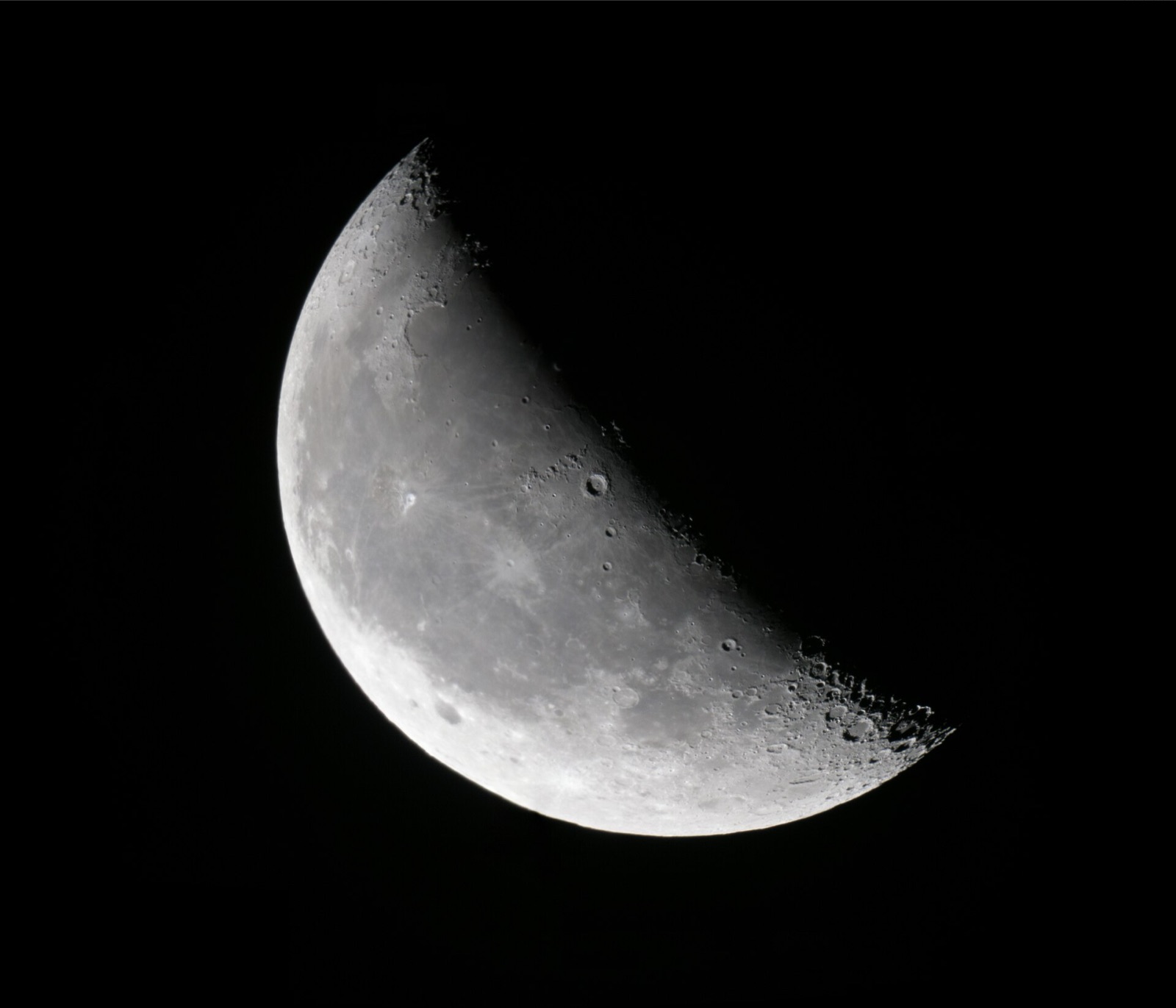

For crater detail, shoot from about four days after new to a few days past first quarter, and again around last quarter, when the same features are lit from the other side. The terminator moves roughly 12° of lunar longitude a day, so each evening a different strip is in low light.
The Moon is small, 29.3′ to 34.1′ across depending on its distance, about half a degree, so crater work needs 600 mm and up. For the sunlit disc the starting exposure is the Looney 11 rule: f/11 at a shutter of 1/ISO for the full Moon, a stop or two more open for the quarters and crescents. The full method, stacking included, is in photographing the Moon with a telephoto lens.
Earthshine and the young Moon
When the Moon is a thin crescent, the dark part of the disc glows faintly with sunlight reflected from Earth. This is earthshine, also called "the old Moon in the new Moon's arms". Seen from the Moon at that time, Earth is nearly full and far brighter than a full Moon is to us, so you can see the maria on the night side. Earthshine is visible for a few days either side of new. It's best at two to four days, when the crescent is thin and the Earth-lit part is large. By five or six days the sunlit part is too bright and you can't see it. Look west after sunset for the waxing crescent, east before dawn for the waning one.
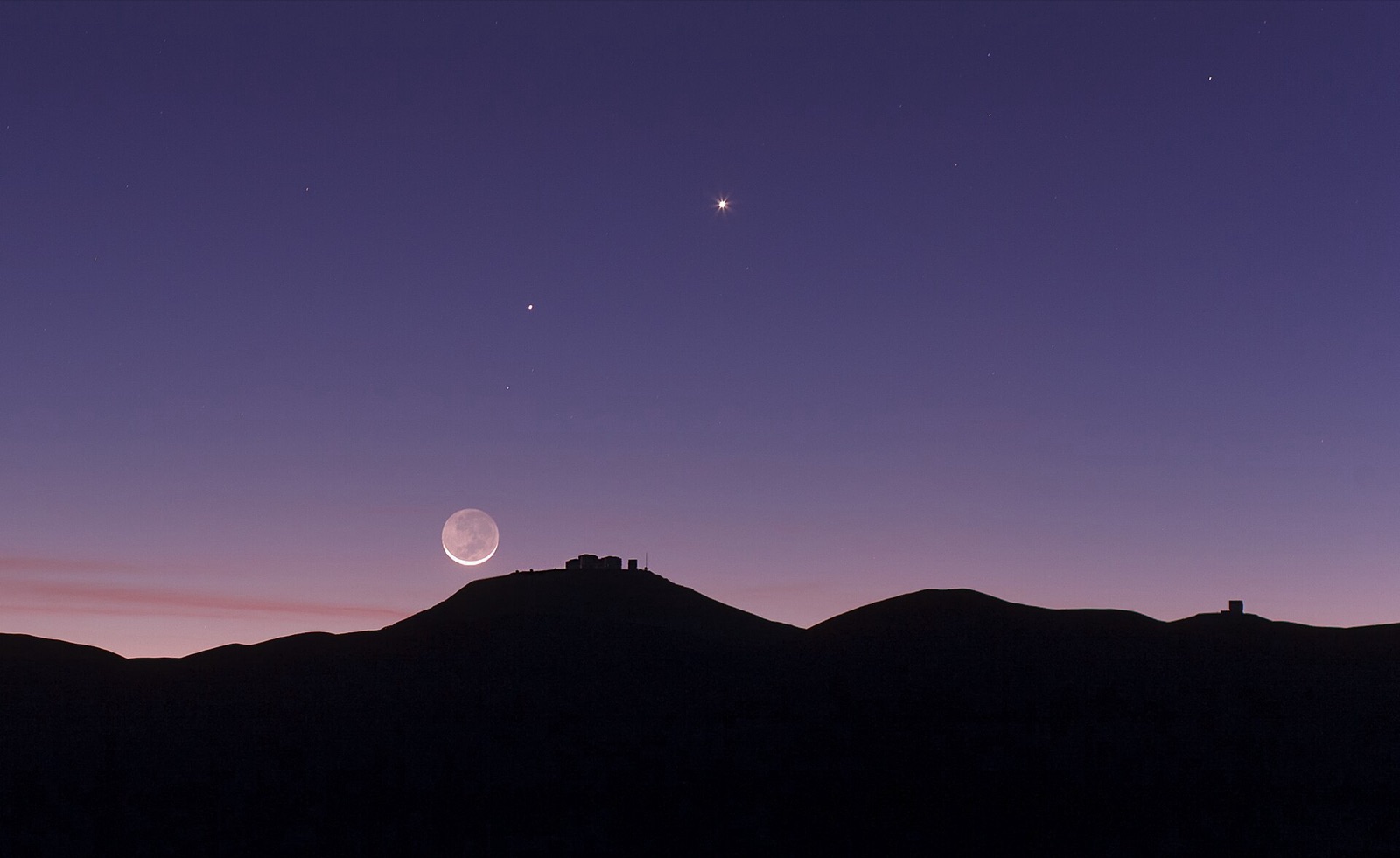

To photograph it, expose for the dark side and let the crescent burn out: about 1–4 s at f/5.6, ISO 800, with a 200–400 mm lens on a tripod. If you want both, take a second frame at the Looney 11 exposure and blend, or bracket and merge as HDR. Shoot while the Moon is still reasonably high. Low down, the atmosphere blurs the faint light.
Some people try to spot the young Moon as soon after new as possible. Under 24 hours old it's a very thin arc a few degrees from the Sun in bright twilight. The naked-eye record is 15 h 32 min, set by Stephen James O'Meara in May 1990. With large binoculars Mohsen Mirsaeed saw one 11 h 40 min after new in 2002. Those are hard to match. For a realistic attempt aim for a 20–30 hour Moon on a spring evening, when the ecliptic is steep, and use the 360° sky to find where it sits relative to the sunset point half an hour after sunset.
The Moon and the Milky Way
The Milky Way's core is a faint, spread-out glow and moonlight washes it out. While a first quarter or brighter Moon is up, there's no point shooting the core. So you choose Milky Way nights by the Moon. Go within about five days of new, or on nights when the Moon sets before the core rises or rises after you've finished. People often overlook that second option. A waning gibbous rising at 11 pm leaves the sky fully dark from astronomical dusk until then, and a waxing crescent setting at 9 pm leaves the whole rest of the night dark.
Best Milky Way nights ranks upcoming nights by the length of the Moon-free dark window while the core is up, combining astronomical twilight, moonrise and moonset with the core's altitude, so a night with a late-rising gibbous Moon can rank above a new-Moon night when the core is low. Open a night in the Planner to see the core's direction and the dark window on the timeline.
Moonlit landscapes: the Moon as a light source
A full Moon is roughly 400,000 times dimmer than the Sun (the measured ratio is about 1/380,000), and that's still enough to light a landscape for a long exposure. Moonlight comes from a small, distant source, so it behaves like sunlight. You get hard shadows, a deep blue sky and full colour. A moonlit scene exposed long enough looks like daytime with stars in it, the "day for night" effect. The sensor records the colours however dim they are. Your eye can't see them because at these light levels it's using its rods, which are colour-blind.


Under a full Moon start at f/2.8, 15 s, ISO 800, or f/2.8, 30 s, ISO 400, and adjust by the histogram, keeping the shutter under your 500-rule or NPF limit. For the daytime look use a daylight white balance (about 5000 K) and expose to the right. For a night look, reduce the exposure a stop or two and use a cooler white balance. A quarter Moon is around three stops dimmer than full, not one, because the surface near the terminator is lit at a grazing angle. Keep the Moon behind you for even light or to one side for more shadow, and keep it out of the frame unless you want the flare.
Best Moon phase for photography, subject by subject
| Subject | Best phase | Why |
|---|---|---|
| Craters and mountains | First or last quarter, ± 2 days | Shadows along the terminator. The full Moon has no shadows. |
| Moonrise over a landscape | Full, or the day before | Rises in the last light with the foreground still lit. |
| Earthshine | 2–4 day crescent | Thin crescent, large Earth-lit disc, still high at twilight. |
| Milky Way core | New ± 5 days, or after moonset | Any bright Moon washes out the core. |
| Star trails | Any but full | Some moonlight helps the foreground. A full Moon brightens the sky too much for long stacks. |
| Conjunctions with planets | Crescent | The inner planets stay near the Sun's side of the sky, and a crescent doesn't overpower them. |
| Lunar eclipse | Full only | Earth's shadow reaches the Moon only at full, and only with an exact alignment. |
| Moonlit landscape | Full and the gibbous days | Enough light for 10–30 s exposures with hard shadows. |
The face we see, and which way up
The Moon spins once in exactly the time it takes to orbit Earth, so the same face is always toward us. This is tidal locking, and it happened because Earth's tides slowed the Moon's spin long ago. The match isn't exact. The Moon's orbital speed varies while its spin is steady, so it appears to rock east–west by up to about 7.9°. Its axis is also tilted to its orbit, so it rocks north–south by up to about 6.8°. These librations let us see a little way around the edges, and over time about 59% of the surface is visible from Earth. Mare Orientale and the craters at the limb only come into view when libration tilts that side toward us. Moon Details shows the current values.
Which way up you see that face depends on where you are. Someone in the southern hemisphere is upside down compared with someone in the north, and sees the Moon rotated 180°. The crescent is rotated too. In the north the waxing crescent is lit on the right and looks like a D. In the south it's lit on the left. Near the equator the crescent rises and sets lying on its back like a bowl. None of this changes the rise and set times (the first quarter still rises at noon everywhere). It only changes how the phase looks.
Common mistakes
- Photographing craters at full Moon. There are no shadows, so there's no relief. Wait for the terminator.
- Planning a Milky Way trip by the phase alone. Check moonset and moonrise, because a late-rising Moon leaves a dark evening.
- Assuming moonrise is at sunset. Only the full Moon rises at sunset. A week later it rises near midnight.
- Exposing crescent and earthshine in one frame. The range is too wide, so bracket or blend.
- Forgetting the Moon is up in daytime. A first-quarter Moon over a sunlit peak is one of the easier shots of the month.
- Expecting a bigger Moon on the horizon. It's the same half-degree. The supermoon guide covers the illusion. A Moon that really is large in a photo comes from a long lens and distance from the foreground, as in Moon behind a landmark. Moonrise azimuth also moves along the horizon through the year like sunrise, so check the Planner's direction line for the date.
FAQ
Are the Moon's phases caused by Earth's shadow?
No. Phases are the changing angle at which we see the Moon's sunlit half as it orbits us. Earth's shadow reaches the Moon only during a lunar eclipse, at full Moon, a couple of times a year.
Why does the Moon rise 50 minutes later each day?
It moves about 12° eastward relative to the Sun each day, and Earth needs about 50 extra minutes of rotation to bring it back to the horizon. The delay varies from roughly 25 to 75 minutes with the angle of the Moon's path to the horizon, and is smallest around the Harvest Moon.
What is the best Moon phase for photography?
It depends on the subject. For surface detail, first or last quarter, when the terminator has long shadows. For a bright disc over a landscape, full or the day before. For earthshine and twilight scenes, a 2–4 day crescent.
Can you shoot the Milky Way with the Moon up?
Not the core. A thin crescent low in the west is fine if it sets early, but a quarter or brighter washes the core out. Plan for new Moon ± 5 days or the hours after moonset.
Is the dark side of the Moon really dark?
No. The far side gets exactly as much sunlight as the near side over a month, and at new Moon it's fully lit. "Dark" here just means we can't see it from Earth.
Sources and further reading
- NASA Science — Moon Phases (why phases happen, the eight phases, the 29.5-day cycle, earthshine, daytime visibility).
- Wikipedia — Lunar month (sidereal month 27.321661 d, synodic month 29.530589 d, and why they differ).
- EarthSky — Harvest Moon (the ~50-minute daily delay, 20–25 minutes at mid-latitudes near the Harvest Moon, the ecliptic-angle explanation).
- EarthSky — What's the youngest Moon you can see? (records: 15 h 32 min naked eye, 11 h 40 min with binoculars).
- Wikipedia — Libration (about 59% of the surface visible over time; longitude and latitude amplitudes).
- The Planetary Society — Can the Moon be upside down? (why the Moon's orientation flips between hemispheres and lies sideways near the equator).