Sun
How to Plan a Sunrise or Sunset Alignment: Manhattanhenge, Arches and Any Landmark
For Manhattanhenge 2026 the full solar disc sat on the city's grid on May 29 and July 11, and the sunrise version comes on December 5 and January 8. Twice a year the setting Sun lines up with Manhattan's cross streets and lights them from end to end. The builders of Stonehenge, Newgrange and Abu Simbel set up the same kind of alignment thousands of years earlier. It can happen anywhere. The Sun's rising and setting point moves along the horizon through the year, so every street, tower and arch has its own two dates when the Sun is exactly in line with it. This guide shows you how to find those dates for any landmark you choose. For the long-lens distance arithmetic, which is the same for the Sun and the Moon, see the huge-Moon guide.
At a glance
- Why it works: sunrise and sunset azimuths swing about ±30° either side of due east and west at 40° latitude (more further north), so a fixed line of sight matches the Sun on two dates a year.
- The method: measure the azimuth to the landmark and its height above the horizon, then scrub the date until the Sun's azimuth at that altitude matches. Shoot both dates and a day either side.
- Lens: the Sun is 0.53° across, which is focal length ÷ 109 on the sensor. 400 mm makes it 3.7 mm wide on full frame.
- Settings for the disc: ISO 100, f/8–11, 1/1000–1/4000 s once the Sun is on the horizon and reddened. Bracket ±2–3 stops. Use live view, never an optical viewfinder on a long lens.
- Afterwards: turn round for the Belt of Venus. If the weather fails, the same spot works for a Moon alignment.
Why the sunrise and sunset point moves along the horizon
Earth's axis is tilted 23.44°, so the Sun's declination runs from +23.44° in June to −23.44° in December, and the point where it crosses your horizon moves with it. Ignoring refraction, the rising azimuth A measured from north satisfies cos A = sin δ ÷ cos φ, with δ the declination and φ your latitude. At the equinoxes δ = 0, so A = 90°, which is due east everywhere on Earth. At the solstices the swing depends on latitude and grows fast toward the poles.
| Latitude | June solstice rise / set | Equinox rise / set | December solstice rise / set | Total swing |
|---|---|---|---|---|
| 0° | 66.6° / 293.4° | 90° / 270° | 113.4° / 246.6° | 47° |
| 30° | 62.7° / 297.3° | 90° / 270° | 117.3° / 242.7° | 55° |
| 40° | 58.7° / 301.3° | 90° / 270° | 121.3° / 238.7° | 63° |
| 50° | 51.8° / 308.2° | 90° / 270° | 128.2° / 231.8° | 76° |
| 60° | 37.3° / 322.7° | 90° / 270° | 142.7° / 217.3° | 105° |
Computed for the Sun's centre on a flat horizon with no refraction. Refraction lifts the Sun about half a degree at the horizon, which at mid latitudes pushes the apparent rise and set points about 0.5° further from due east and west. So at 40° N you see the Sun set at about 302° in late June and 240° in late December, the figures the twilight guide uses for Philadelphia.
So any landmark inside the swing lines up with the Sun on two dates a year, one on each side of the nearest solstice. A street facing 270° gets the equinox Sun in March and September, and one facing 300° gets it in late May and mid July. A landmark at the end of the swing gets it once, and the Sun stays there for a week or two.
Manhattanhenge 2026, Stonehenge and the other famous alignments
| Place | Effect | When |
|---|---|---|
| Manhattanhenge, New York | Setting Sun framed by the cross streets. The grid is rotated about 29° from true east–west, so it aligns at ~299° | Around May 28–30 and July 11–13 (2026: full disc May 29 and July 11, half disc May 28 and July 12). Sunrise version around December 5 and January 8 |
| Chicagohenge | A true east–west grid, so the Sun rises and sets down the streets at the equinoxes | March 20–23 and September 19–22 (2026) |
| Torontohenge | Same effect on a grid skewed the other way | Sunsets around February 15–16 and October 25. Sunrises around April 19 and August 23 |
| Stonehenge | Summer solstice Sun rises behind the Heel Stone on the north-east axis. The same axis lines up with the winter solstice sunset | June 20–21 sunrise, December 21–22 sunset |
| Newgrange, Ireland | Sunrise beam enters through a roof-box over the door and runs 62 ft up the passage for about 17 minutes | December 19–23, sunrise ~8:58 am |
| Abu Simbel, Egypt | Rising Sun reaches the sanctuary statues at the back of the Great Temple, all except Ptah, god of the underworld | February 22 and October 22 |
| Chichén Itzá, Mexico | Late-afternoon Sun casts a row of light triangles down El Castillo's north balustrade, which looks like a serpent descending | Around the equinoxes, for several weeks either side |
| Mesa Arch, Utah | Sunrise light bounces off the cliff below and makes the underside of the arch glow orange | Any clear morning, first hour after sunrise |
| Delicate Arch, Utah | The last sunlight turns the arch red against the La Sal mountains | Any clear evening |
Manhattanhenge's dates fall on either side of the June solstice, Torontohenge's the December one, and Chicagohenge sits on the equinoxes because its grid is true. The Utah arches are lighting effects rather than azimuth alignments, which is why they work on any clear day.
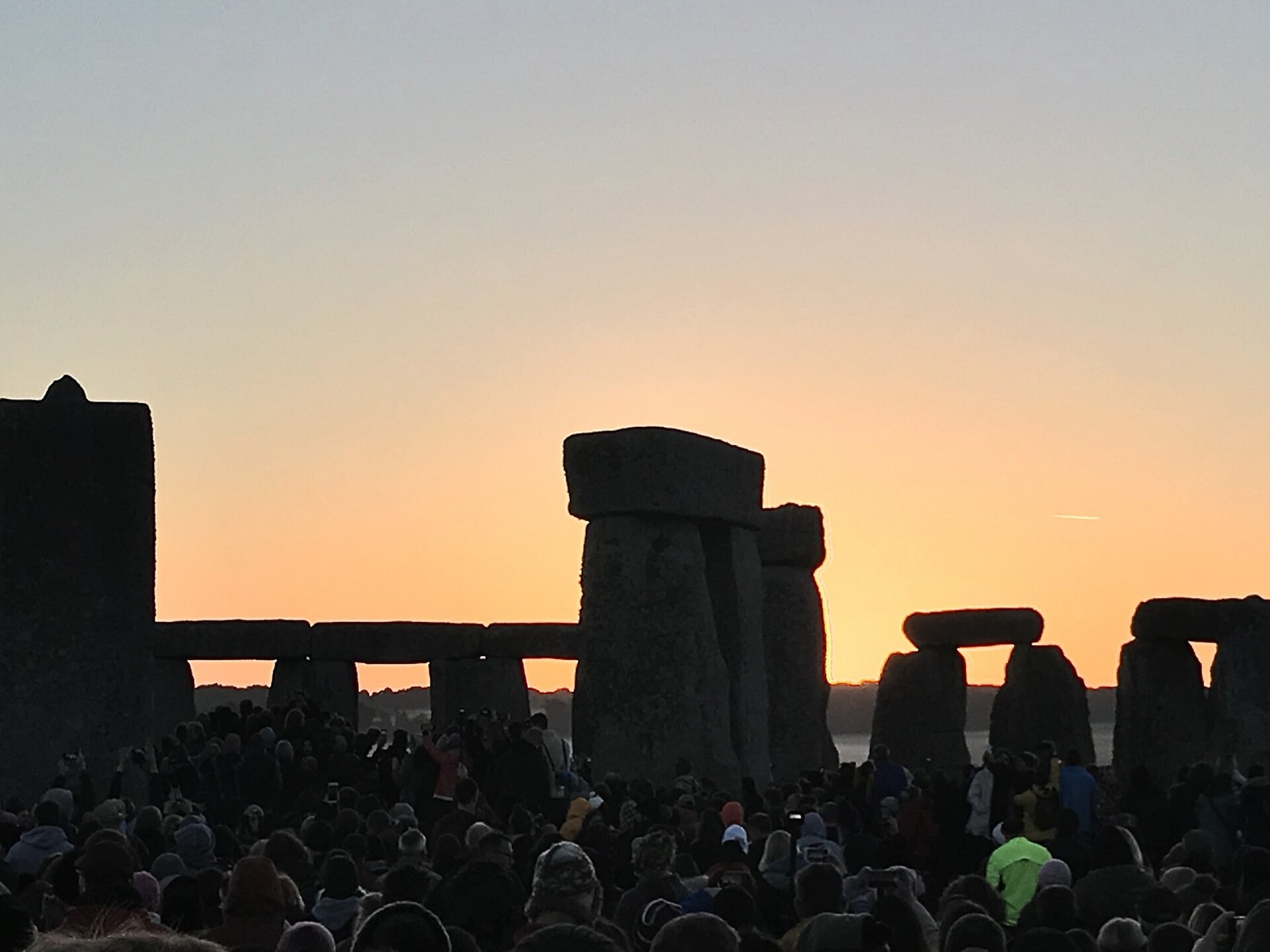

How to plan a sun alignment for any landmark
- Choose the landmark and the effect. It could be the Sun on the horizon at the end of a street, the disc rising behind a tower, a sun star from the edge of an arch, or a lighthouse silhouetted against the disc. Each needs a different Sun altitude (0° for the street, 1–3° for a tower), and the altitude affects the date as much as the azimuth does.
- Measure the azimuth and altitude of the landmark from your spot. Draw the line on a map and read the true bearing. A tower top 100 ft above eye level at 3,300 ft subtends 1.7° (height ÷ distance × 57.3). For a long-lens shot, use the distance table in the huge-Moon guide as it is. The Sun covers about 46 ft of subject per mile.
- Find the dates when the Sun passes that azimuth at that altitude. The Sun doesn't climb straight up from where it rises, except at the equator. At 40° N its path leaves the horizon at about 50°, so by the time it has climbed 1.7° it has drifted about 1.4° to the right (south) of the rising point. At 60° N the drift is nearly twice the climb. So a tower alignment needs a different date from a horizon alignment on the same bearing, and the date sets the time, which is about nine minutes after sunrise for 1.7° at 40° N. Set the date and time, read the azimuth, and adjust the date until it matches. This step takes patience, and the shot depends on getting it right.
- Shoot both dates and a day either side. Near the equinoxes the rising point moves about 0.4° per day at the equator, 0.5° at 40° N and 0.8° at 60° N. That's a Sun-width or more, so being one day off is visible. Near the solstices it hardly moves for two weeks.
- Size the Sun and pick the lens. The disc is 0.53° across, almost the same size as the Moon, so its image is focal length ÷ 109: 3.7 mm at 400 mm, 5.5 mm at 600 mm on a 36 mm-wide frame. A 100 ft tower at 3,300 ft is three Suns tall. At 2 miles it's one. To change that ratio, change the distance, not the lens.
The Planner in Still Dark draws the Sun's direction line on the map for any date and time, so pointing it through the landmark from your spot shows whether they line up. The "stand here" alignment moves the observing point onto the line for a target behind the landmark, the camera field-of-view overlay shows how much of the tower your focal length holds, and the altitude curve on the timeline gives the Sun's height at the chosen minute. To find the dates, scrub the date until the line lands on the landmark. It will do that twice a year.
Refraction, horizons and hills
Refraction. A Sun seen on the horizon is really about 34′ below it. The USNO adds the disc's 16′ semidiameter and defines sunrise as the centre 50′ down. The Sun rises a few minutes early, sets a few minutes late, looks flattened, and its azimuth is shifted about half a degree outward at mid latitudes. Planning tools include this. If you calculate by hand, you have to add it.
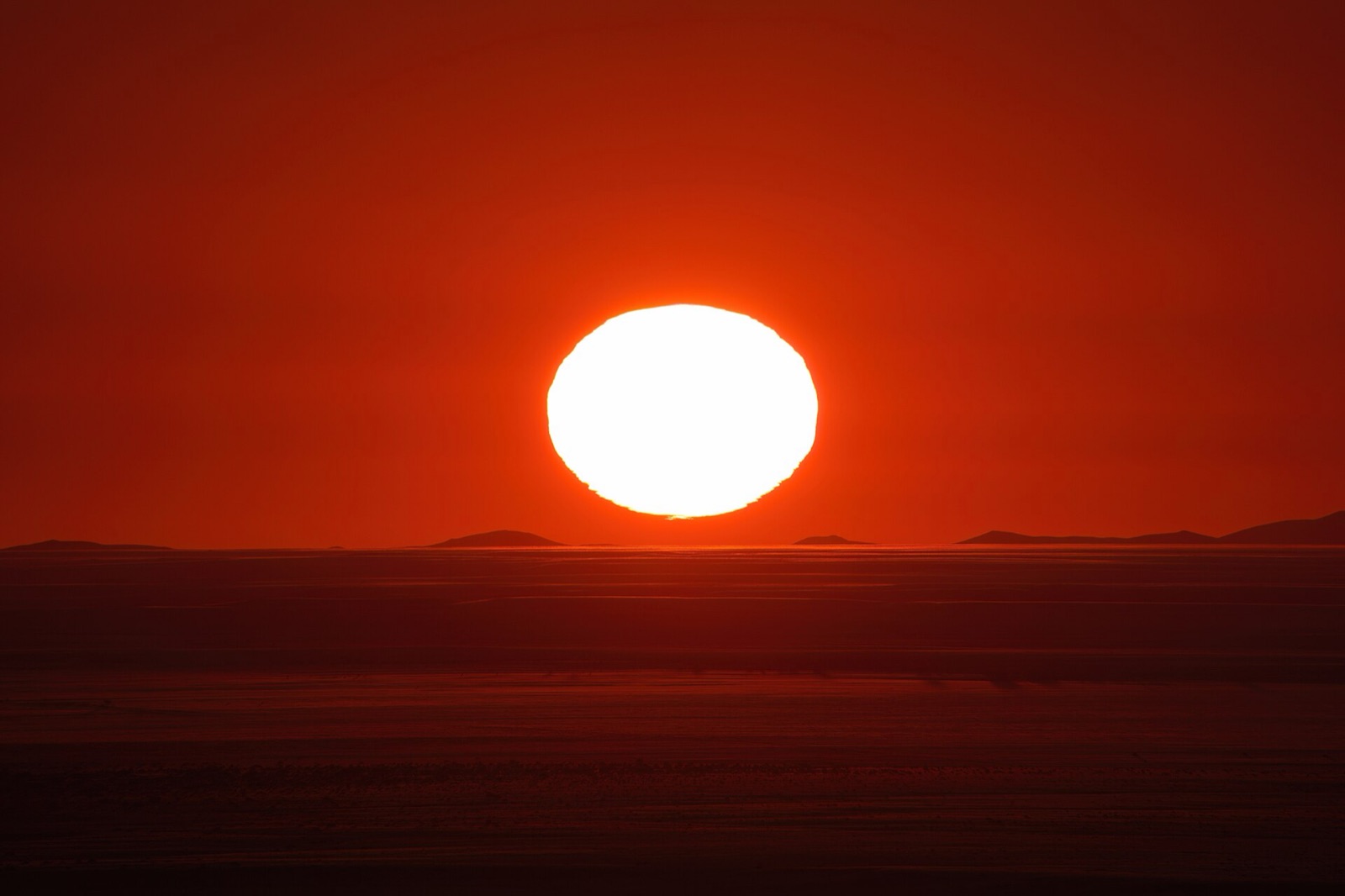

A raised horizon. Only a sea horizon is a true 0°. A skyline, ridge or tree line is a horizon of 1°, 3° or 10°, which the Sun reaches later and further along its diagonal. Behind a 3° ridge at 40° N the sunset azimuth differs by 2–3° from the table and the time by a quarter of an hour.
Sun stars and silhouettes
A sun star comes from a small aperture and a partly hidden Sun. Stop down to f/16 or f/22 (the number of spikes is the number of aperture blades, or twice that for an odd count) and wait for the moment the Sun's edge just clears the arch, the building corner or the ridge. A sliver gives sharp spikes and a whole disc gives a blob. You only have a few seconds.
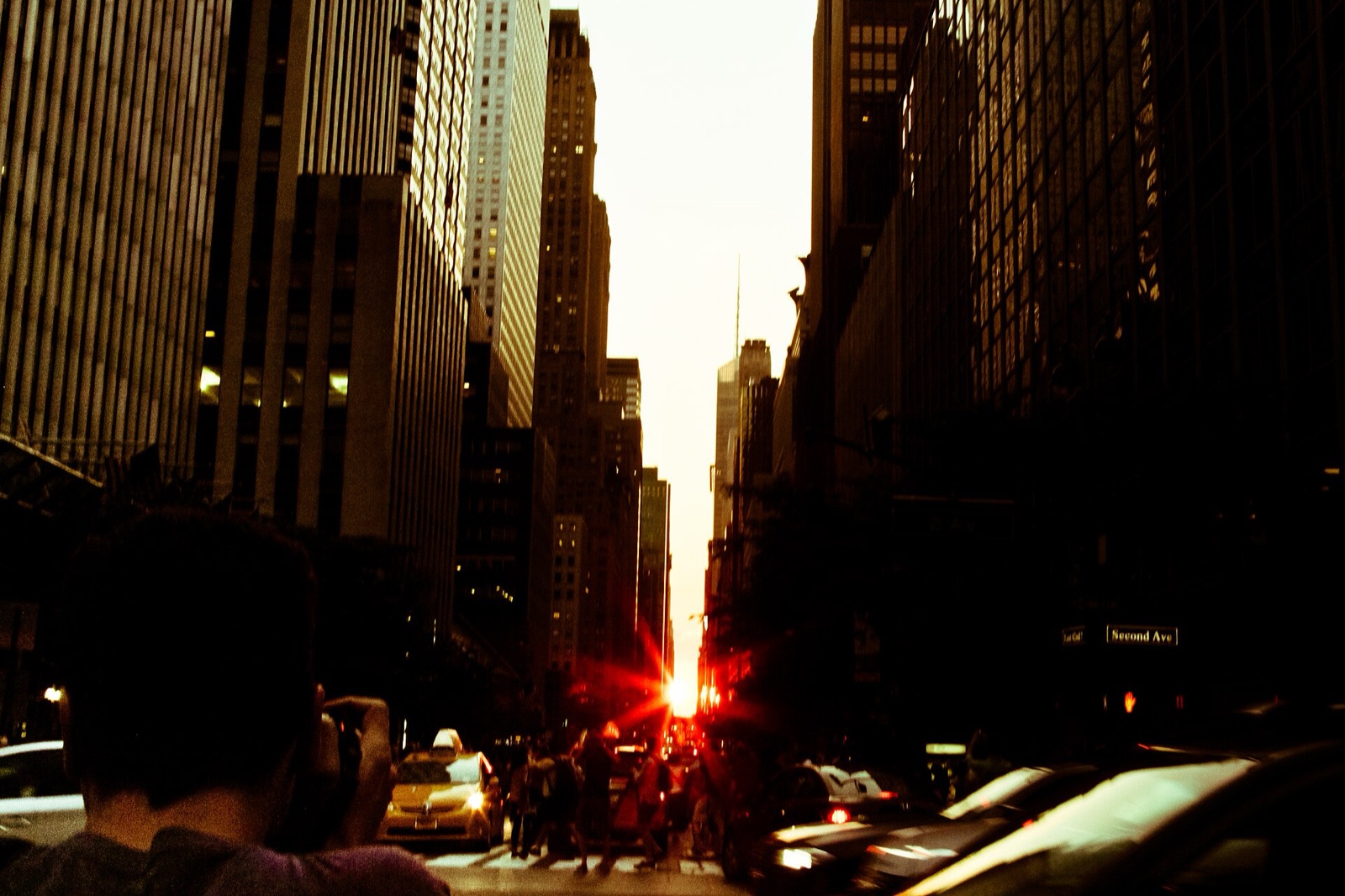
.jpg)
A silhouette needs the opposite, which is the whole disc, low and red, with the subject small enough to fit inside it. That comes down to distance and focal length, the same as for the Moon. The Sun also has to be low enough for the atmosphere to dim it.
Camera settings for the setting Sun, and safety
At noon the Sun is about magnitude −26.7. On the horizon its light crosses roughly forty times as much air and it falls to somewhere near −15.8. That's well over ten stops, though it varies a lot with haze, and it's why you can photograph a sunset Sun without a filter at all. For the disc on the horizon, once it's visibly orange, use ISO 100, f/8–11, 1/1000–1/4000 s and bracket ±2–3 stops, because the brightness changes by the minute. Expose for the Sun and let the landmark go black. If you want foreground detail, shoot a longer frame and blend. Keep the shutter fast, because the Sun crosses its own width every two minutes.
Don't take chances with your eyes. A low, deep-red Sun is safe to glance at with the naked eye. It is not safe to study through a telephoto, which concentrates the disc onto your retina, and the moment the haze thins or the Sun climbs a degree the light is far stronger. Compose on live view or an electronic viewfinder, never an optical one, and never through a long lens at a Sun that is still white or yellow. Don't leave a telephoto pointed at the Sun between frames either, because the focused image can damage the shutter. For a higher Sun you need a front-mounted solar filter.
The Sun & Moon card gives sunrise and sunset times and azimuths for your location on any date, and Camera Tools has an exposure recipe for the Sun to start bracketing from. Check Weather for low cloud the evening before. A clear sky overhead doesn't help if there's a bank of cloud on the horizon.
Plan B: turn round, or wait for the Moon
If the sunset is dull, turn around. Opposite the sunset the pink Belt of Venus and Earth's blue-grey shadow rise over the eastern horizon for twenty minutes or so (see the twilight guide). If the weather fails on both dates, you can use the same spot for the Moon. The full Moon rises near your landmark's azimuth on some other date, and a thin crescent follows the Sun into the same western gap at dusk a few days after new. The huge-Moon guide covers how to find the dates, and the Moon gives you another chance every month.
Timeline checklist
- A month out: measure azimuth and altitude from two or three candidate spots, find the two dates for each, and note the minute the Sun reaches the right altitude.
- A week out: watch the forecast for both dates. Pick the clearest horizon, not the clearest sky.
- The evening before: scout the spot at the same time of day. Check the line of sight, footing and parking, and take a test frame at the planned focal length.
- The day: arrive 45 minutes early. Set up, focus on the landmark, switch to live view, dial in the bracket, and start shooting a couple of minutes before the computed time.
Common mistakes
- Planning for the flat horizon when the landmark itself is the horizon. The Sun reaches a tower top later and further along its path.
- Only one date. Every alignment away from the solstice azimuth has a twin on the other side of the solstice.
- Trusting a magnetic compass. Azimuths here are true, so correct for local magnetic declination, or use the map.
- An optical viewfinder on a telephoto. Live view only, and only once the disc has reddened.
- Arriving at sunset. Have the composition ready before the disc appears.
FAQ
When is Manhattanhenge 2026?
The sunsets fall around May 28–30 and July 11–13. For Manhattanhenge 2026 the full disc sat on the grid on May 29 (8:13 pm) and July 11 (8:20 pm). The sunrise version falls around December 5 and January 8. Look west along a wide cross street such as 14th, 34th, 42nd or 57th, and be in position half an hour early.
Why does a landmark line up with the Sun twice a year?
The rising and setting azimuth swings out to a maximum at one solstice and back through the same values to the other, so any azimuth inside the swing is crossed once each way. Only the two solstice azimuths are reached once.
How far does the sunset point move each day?
About half a degree a day near the equinoxes at 40° N (0.4° at the equator, 0.8° at 60° N), which is one Sun-width, and almost nothing for a couple of weeks around each solstice.
Is it safe to photograph the setting Sun without a filter?
Once the Sun is on the horizon and visibly reddened, yes, using live view or an electronic viewfinder and fast shutter speeds. Never look through an optical viewfinder with a long lens, and use a proper solar filter for a Sun that is still bright.
What focal length do you need for a sunset alignment?
First decide how big the Sun should be against the landmark. That sets your distance, because the disc covers about 46 ft per mile. Then choose a lens that fills the frame. The Sun's image is focal length ÷ 109, so 400 mm gives a 3.7 mm disc on full frame.
Sources and further reading
- American Museum of Natural History — Manhattanhenge 2026: When, Where & How to See It (the 2026 dates and times; viewing streets); Wikipedia — Manhattanhenge (the 29° grid rotation, the December/January sunrise dates, Chicagohenge, Torontohenge).
- Adler Planetarium — Understanding Chicagohenge (2026 dates and why a true east–west grid aligns at the equinoxes).
- U.S. Naval Observatory — Rise, Set, and Twilight Definitions (34′ refraction, 16′ semidiameter, 50′ depression at sunrise).
- Asterism.org — Atmospheric Extinction and Refraction (the Sun's magnitude at noon versus the horizon, airmass ~40 at the horizon).
- English Heritage — Solstice at Stonehenge; Newgrange.com — Winter Solstice at Newgrange (Heel Stone sunrise; the December 19–23 beam lasting about 17 minutes).
- NASA — Eclipse and Solar Viewing Safety (never view the Sun through a lens without a front-mounted solar filter).