Eclipses
How to Photograph a Lunar Eclipse (Settings for Every Phase)
During a total lunar eclipse you change exposure more than for any other night subject. Over three hours the Moon goes from the brightest thing in the sky to a dim copper disc ten to twelve stops fainter, and then back. To come home with the whole sequence you need to know the exposure for each phase before it happens. So this guide to how to photograph a lunar eclipse is mostly numbers. It covers the settings by phase, the focal length to use and how to plan where the Moon will be through the night. People usually ask about solar eclipses at the same time, so the safety basics for photographing a solar eclipse are here too.
At a glance
- Full / penumbral Moon: ISO 100–200, f/8–f/11, 1/250–1/500 s.
- Partial phases: ISO 100–400, f/6.3–f/8, 1/125–1/250 s, bracketed ±1 stop, slowing as the shadow grows.
- Totality: ISO 800–3200, f/4–f/6.3, 0.5–4 s. Keep it under 1–2 s untracked or the Moon blurs.
- Lens: 300 mm and up for the Moon itself, and 14–35 mm for the Moon in a landscape.
- No filter needed for a lunar eclipse. A solar eclipse needs a certified ISO 12312-2 filter on the front of the lens for every phase except totality.
When is the next lunar eclipse?
As of September 2026, this year's two lunar eclipses (the total eclipse of March 3 and the partial of August 27–28) have passed. 2027 has three lunar eclipses, on February 20, July 18 and August 17, and all three are penumbral. You'll see a slight shading on one edge of the Moon, which is worth a frame or two but not a sequence. The next partials are January 11–12 and July 6–7, 2028. The next total lunar eclipse is the night of December 31, 2028 into January 1, 2029, so you have time to practise.
For the Sun, an annular eclipse crosses parts of South America, the Atlantic and West Africa on February 6, 2027. The total solar eclipse of August 2, 2027 runs across southern Spain, North Africa and the Arabian Peninsula, with totality lasting up to 6 minutes 23 seconds, the longest of the century on land. We have a separate guide to the 2027 eclipse with the path, times and settings.
Still Dark lists the next solar and lunar eclipse with the local circumstances for your location (whether it's visible from where you are, the maximum coverage and the timing) in Sun Details, Moon Details and the Sky Events calendar.
The stages, and why totality's brightness varies
A lunar eclipse has three parts. In the penumbral phase the Moon is in Earth's outer shadow. The naked eye sees almost nothing and the camera sees a faint gradient. In the partial phase the dark umbra moves across the disc. The Moon looks like a crescent, and the difference in brightness between the lit and shadowed parts is very large. At totality the whole Moon sits inside the umbra, lit only by sunlight bent through Earth's atmosphere. That light is the colour of a sunset, which is why the Moon turns copper.

How bright totality is depends on the eclipse. Volcanic dust and the Moon's path through the shadow make the difference between a bright orange Moon and a brown one you can hardly see. Astronomers rate it on the Danjon scale, L0 (very dark) to L4 (bright copper-red with a bluish rim). Because it varies, totality exposures are given as a range, and you should bracket instead of trusting a single number, including ours.
Planning the night
- Contact times for your location: when the partial phase starts, when totality begins and ends, when the partial phase ends. The app gives them in local time.
- The Moon's altitude and azimuth through the night. For a landscape composition you need to know where the Moon will be during totality, and whether it's high enough to clear buildings and haze. Some eclipses end with the Moon setting in totality. For those, pick a spot with a low western horizon.
- Weather. The whole event runs three hours, so a cloud-layer forecast matters more than a percentage.
- Two set-ups if you can: a long lens for the Moon's face and a wide lens for the Moon in the scene, so you don't have to choose.
What lens for a lunar eclipse: focal length and the size of the Moon
The Moon's image on the sensor is the focal length divided by 109. At 300 mm it's 2.8 mm across on a full-frame sensor, enough for a clean disc with detail. At 600 mm it's 5.5 mm, and at 1200 mm it's 11 mm, a third of the frame width. For a sequence composite across the sky, 24–50 mm keeps the whole arc in one frame with the Moon as a small but recognisable disc. A crop-sensor body effectively multiplies the focal length by 1.5×. If you're new to long lenses on the Moon, the telephoto Moon guide covers sharpness and atmosphere.
Lunar eclipse camera settings by phase
| Phase | ISO | Aperture | Shutter | Notes |
|---|---|---|---|---|
| Full Moon, before contact | 100–200 | f/8–f/11 | 1/250–1/500 s | The "Looney 11" baseline: f/11 at 1/ISO. |
| Penumbral | 100–200 | f/8–f/11 | 1/250–1/500 s | Same as full. The shading is faint. |
| Partial, early (up to ~30% covered) | 100–400 | f/6.3–f/8 | 1/125–1/250 s | Bracket ±1 stop. Expose for the lit part. |
| Partial, deep (60–90% covered) | 400 | f/8 | 1/60–1/125 s | The lit sliver blows out if you expose for the shadow, so pick one. |
| Totality (bright, L3–L4) | 800–1600 | f/4–f/5.6 | 0.5–1 s | Bracket widely. |
| Totality (dark, L0–L2) | 1600–3200 | f/4 | 2–4 s | Needs a tracker beyond ~2 s at 300 mm+. |
| Wide-field, Moon in landscape at totality | 800–3200 | f/2.8–f/4 | 10–30 s | Stars show up. The Moon is a red disc. |
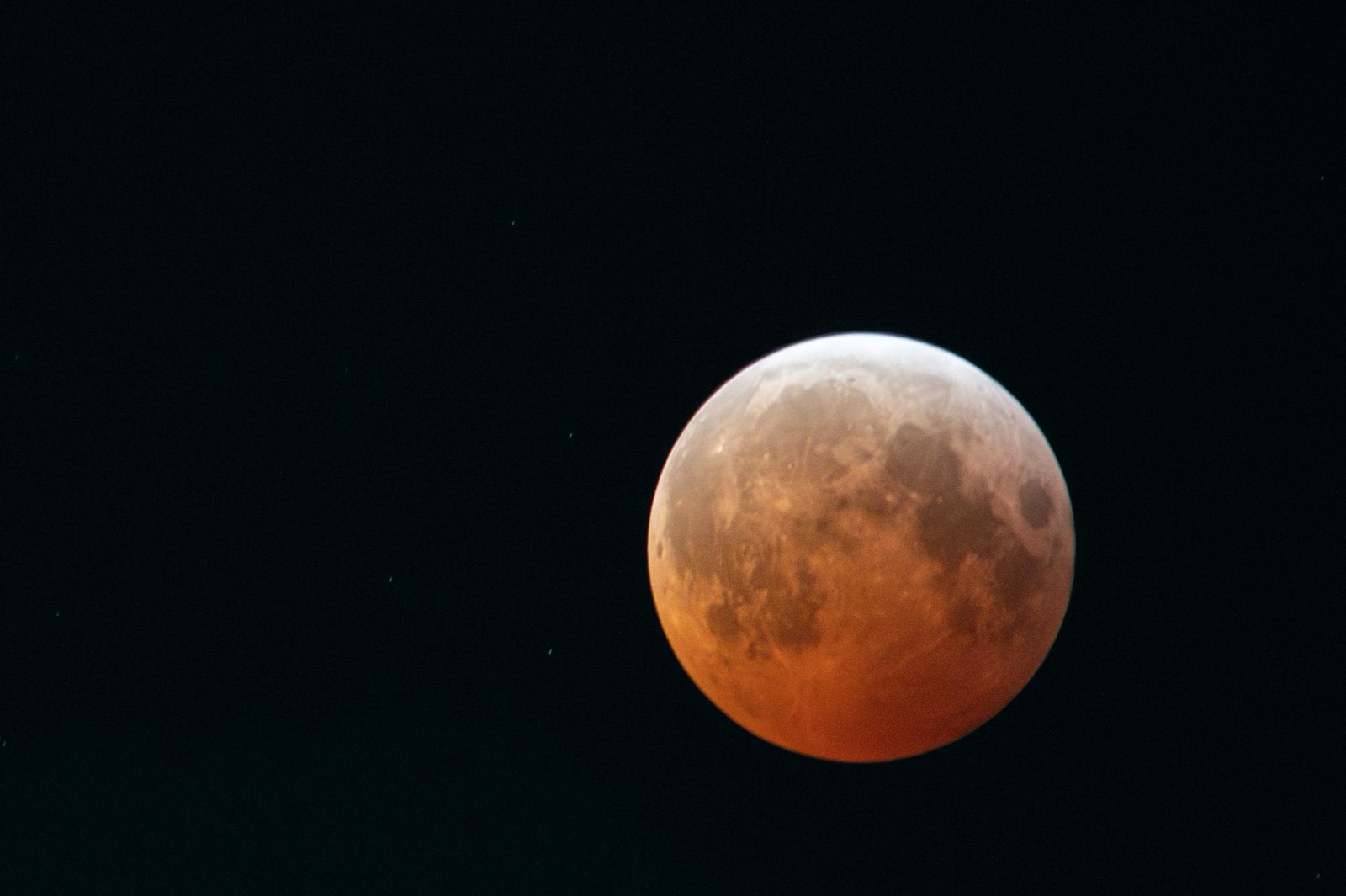
The Moon moves its own diameter every two minutes. At 300 mm you'll see blur beyond about 2 seconds, and at 600 mm beyond 1 second. Raise the ISO instead of lengthening the shutter, or put the lens on a star tracker.
How to photograph a lunar eclipse: the workflow on the night
- Manual everything, RAW. Focus at 100% magnification on the Moon's limb or on craters near the terminator, then turn autofocus off and leave it off.
- Bracket: three frames ±1 stop at each moment during the partial phases, and five frames over ±2 stops in totality.
- Shoot on a schedule. A frame every 5 or 10 minutes from first contact to last gives a clean sequence. Shoot more often in the minutes around the start and end of totality, when the colour changes fastest.
- Re-check focus and exposure every 20 minutes. Temperature shifts focus, and the Moon's brightness changes by whole stops. It gets tedious, but keep doing it.
- Keep the same framing if you're building a composite of the Moon's path. Put the Moon in one corner at the start and let it drift across.
Composition ideas
- The sequence: the Moon every ten minutes across one wide frame, going from bright to red and back. This is the classic eclipse picture.
- Totality in a landscape: the red Moon over a skyline, ridge or sea, with stars. You can't do this at an ordinary full Moon, but in totality it's easy.
- The face: a single long-lens frame of the copper Moon with its faint blue rim.
- Time-lapse: a frame every 15–30 seconds at fixed settings per phase.

Common mistakes
- One exposure all night. The Moon changes by ten stops, so the settings have to change with it.
- Autofocus, which hunts on the dim red disc.
- Not bracketing totality. You can't know in advance how dark it will be.
- Too long a shutter at long focal length.
- A phone's digital zoom, which adds no detail. Hold the phone to binoculars or a telescope eyepiece instead.
Solar eclipse safety basics
Everything above is for the Moon, which is safe to look at and to photograph unfiltered. The Sun is not safe to look at or to photograph without a filter.
- A certified solar filter (ISO 12312-2), a metal-coated glass or film filter of about ND 5.0, sixteen stops, goes on the front of the lens for every partial and annular phase. Never a rear-mounted filter, never stacked ND filters, never sunglasses, never a polariser.
- Use live view, not an optical viewfinder, to compose and focus. Concentrated sunlight through a lens damages eyes and sensors in seconds.
- Remove the filter only at totality (second contact), when the Sun's disc is completely covered, and put it back the instant the diamond ring reappears (third contact). During an annular eclipse the filter stays on throughout, because the ring is still the Sun.
- Sample exposures at ISO 100, f/8: partial phases through the filter 1/500 s, Baily's beads 1/4000 s, prominences 1/1000 s, inner corona 1/250 s, outer corona 1/15 s to 4 s. Bracket everything, because the corona spans twelve stops.
- Practise on the full Sun beforehand, filter on, so you can do it all without thinking during the two to six minutes of totality.
FAQ
What are the best camera settings for a blood Moon?
At totality, start at ISO 1600, f/4, 1 second, and bracket two stops either way. The copper Moon varies from eclipse to eclipse, so check the histogram and adjust.
Do I need a solar filter for a lunar eclipse?
No. The Moon only reflects sunlight, and it's safe to look at and photograph. Filters are only for the Sun.
What lens do I need to photograph a lunar eclipse?
For the Moon's face, 300 mm or longer (the Moon is focal length ÷ 109 mm across on the sensor). For the Moon in a landscape, 14–35 mm. Many people bring both.
When is the next total lunar eclipse?
The night of December 31, 2028 into January 1, 2029. Before that there are partial eclipses on January 11–12 and July 6–7, 2028. The three eclipses in 2027 are penumbral only.
Can I photograph a lunar eclipse with a phone?
Yes. Put it on a tripod, use night mode for totality, and for the Moon's face hold it to a pair of binoculars or a telescope eyepiece. Don't use the digital zoom.
Sources and further reading
- Fred Espenak — Lunar eclipse photography (image size = f ÷ 109, the Danjon scale) and Nikon's guide (exposures by eclipse magnitude).
- AstroBackyard — How to Photograph a Lunar Eclipse and a Solar Eclipse.
- American Astronomical Society — Solar eclipse imaging and safety; Sky at Night — solar eclipse exposures.
- Eclipse dates: EclipseWise; timeanddate.