Sky calendar
What's in the Sky in December 2026: Moon, Planets, Meteors and What to Photograph
December 2026 has the best meteor night of the year and the biggest full Moon of the year, ten days apart. Those two are the main events in what's in the sky in December 2026. The Geminids peak on December 13–14 under a crescent Moon that sets by mid-evening, and the Cold Moon on December 24 is full seven hours before perigee, the closest full Moon of 2026. The solstice falls on December 21. Venus is the morning planet and Saturn the evening one. Jupiter and Mars rise together in Leo before midnight, both heading for February oppositions. If you only go out once, make it the Geminids from a dark site after moonset.
At a glance
- Dec 9: new Moon at 00:51 UTC. The dark window for deep sky runs from about Dec 4 to 14.
- Dec 13–14: Geminids peak, predicted for 05:44 UTC on the 14th, with up to 120 an hour. The 21% crescent sets around 9 pm local.
- Dec 21: solstice at 20:50 UTC. That evening the Moon passes 1° from the Pleiades.
- Dec 24: Cold Moon, full at 01:28 UTC and at perigee at 08:30 UTC (221,612 miles), the closest full Moon of the year.
- Dec 27–28: Moon, Jupiter and Mars rise together in Leo late in the evening, with Jupiter 1.5° from the Moon on the 27th and Mars 4.8° on the 28th.
What's in the sky in December 2026, date by date
All times are UTC, so convert to your local time.
.jpg)
| Date (UTC) | Event | How to see it |
|---|---|---|
| Dec 1, 06:08 | Last quarter Moon | Evenings are Moon-free from this date. |
| Dec 5, 06:00 | Moon 6.6° from Venus | Pre-dawn, south-east. 12% crescent. |
| Dec 9, 00:51 | New Moon | Darkest skies, Dec 4–14. |
| Dec 12 | Jupiter stationary near Regulus | Retrograde toward the Feb 11 opposition begins. |
| Dec 14, 05:44 | Geminids peak | After moonset on the 13th until dawn. |
| Dec 18, 05:00 | Moon 6.2° from Saturn | Evening, south. 68% Moon. |
| Dec 21, 20:50 | December solstice | Longest night in the north. |
| Dec 21, 22:37 | Moon 1.0° from the Pleiades | Evening. 93% Moon on the cluster's south edge. |
| Dec 22, 20:59 | Ursids peak | 5–10 an hour under a 98% Moon. |
| Dec 24, 01:28 | Full Moon (Cold Moon), supermoon | In Gemini. Rises around sunset on Dec 23 and 24. |
| Dec 24, 08:30 | Moon at perigee, 221,612 mi | Closest of 2026. |
| Dec 27, 17:32 | Moon 1.5° from Jupiter | Rise together about 10 pm local, east. |
| Dec 28 | Moon 4.8° from Mars | The rising Moon again, one night later. |
December 2026 full Moon: the Cold supermoon and the dark window
Last quarter December 1 (06:08 UTC), new December 9 (00:51), first quarter December 17 (05:42), full December 24 (01:28), last quarter again December 30 (18:59). December's full Moon is the Cold Moon, also called the Long Night Moon, and the second name fits, because it's up longer and climbs higher than any other full Moon of the year, opposite the low December Sun.
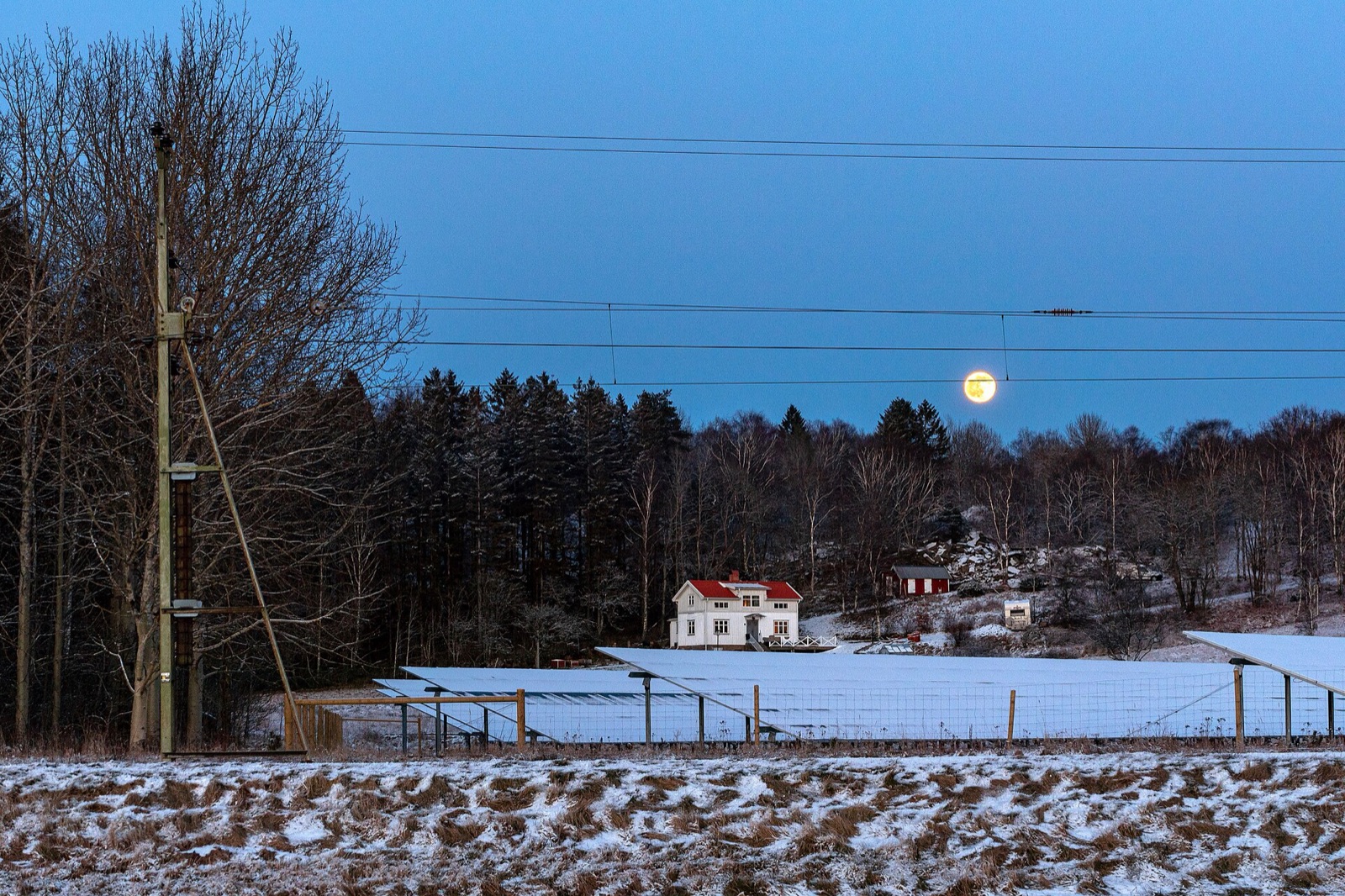

It's also the closest full Moon of 2026. It's full at 01:28 UTC on December 24 and at perigee at 08:30 UTC at 221,612 miles, and it's about 221,668 miles away at the instant of full phase. It counts as a supermoon under any of the usual definitions. The disc spans about 33.5′, some 14% wider and 30% brighter than the year's apogee full Moon in May. You won't notice the size by eye, but you will in a telephoto frame next to a building.
The dark window. The Moon-free stretch runs from about December 4 to 14, so it covers the Geminids. Early on the waning crescent rises a couple of hours before dawn, and later the waxing crescent is down by 9 or 10 pm. A second window opens from December 29, when the last-quarter Moon rises after midnight.
The Sun & Moon card gives Moon rise and set, phase, illumination, distance and angular size for your location. Moon Details tracks the run-up to perigee. Take the moonrise time for December 23 or 24 into the Planner to place the supermoon behind a landmark.
Planets visible in December 2026
Mercury is at the end of its November morning apparition (greatest western elongation November 20, superior conjunction January 1, 2027). On December 1 it's magnitude −0.5 and 17° from the Sun, very low in the south-east at dawn, and it's gone by the second week.
Venus is the morning star at magnitude −4.5, fading to −4.3. Mid-month it rises nearly four hours before the Sun and stands almost 30° high in the south-east at civil twilight from mid-northern latitudes, on its way to greatest western elongation on January 3, 2027. That's high enough to photograph above the haze near the horizon. The crescent Moon passes 6.6° from it on the morning of December 5 (photographing Venus).
Mars is a late-night and morning object in Leo, brightening from magnitude +0.5 to −0.1 during the month on its way to opposition on February 19, 2027. It rises around 10 pm local mid-month. The disc is only 8–10″, so shoot wide frames with Jupiter and Regulus this month and leave surface detail for February.
Jupiter shares Leo with Mars, a few degrees from Regulus, and at magnitude −2.1 to −2.2 it's the brightest thing in the east in the late evening. It's up by about 9:30 pm local mid-month. It's stationary around December 12, then retrogrades toward its February 11, 2027 opposition.
Saturn is the evening planet. It's magnitude +0.7 to +0.8 on the Pisces–Cetus border, about 48° high in the south at 6 pm from mid-northern latitudes and setting around 1 am. The rings are nearly edge-on and look thin. The tilt reaches its minimum of about 6° on December 6.
Uranus (magnitude +5.6, Taurus) is a fortnight past opposition and up all night for binoculars, and Neptune (magnitude +7.9, Pisces) is about 6° west of Saturn.
Meteor showers in December 2026: Geminids and Ursids
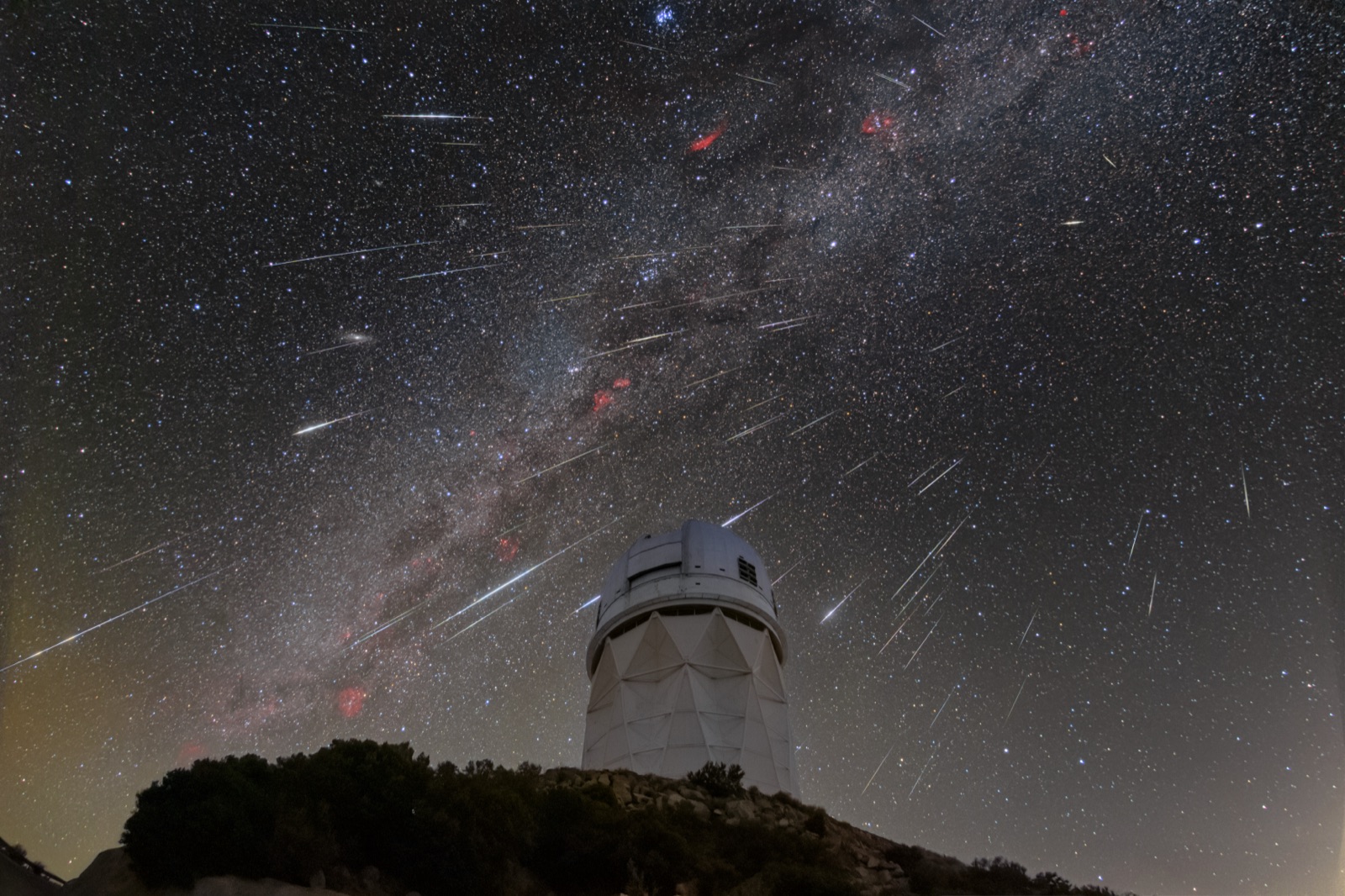
Geminids, peak December 13–14. Predicted maximum 05:44 UTC on the 14th. The Geminids are the richest annual shower, zenithal hourly rate 120 (some forecasts say 150), with slow, bright meteors from a radiant near Castor that's highest around 2 am local. The parent body is the asteroid 3200 Phaethon. This year the Moon is a 21% waxing crescent that sets at 8:42 pm in New York on the 13th, and about as early elsewhere. After that the sky is dark until dawn, so conditions are excellent. Dress warmly.
Ursids, peak December 22. Predicted maximum 20:59 UTC, radiant near Kochab in the Little Dipper. The usual rate is 5–10 an hour, and a 98% Moon is up all night, so conditions are poor. The next dark-sky shower is the Quadrantids on January 3–4, 2027, covered in the January 2027 sky guide.
From the southern hemisphere the Geminid radiant is low and clears the northern horizon around midnight. The Ursids never rise.
Conjunctions and close approaches
- Dec 5, morning: Moon and Venus, 6.6°. Crescent with earthshine, Venus above it in the south-east from about 4 am. Use 50–85 mm.
- Dec 18, evening: Moon and Saturn, 6.2°. Expose for the Moon, and Saturn will show as a point. Use 100–135 mm.
- Dec 21, 22:37 UTC: Moon and the Pleiades, 1.0°. A 93% Moon on the cluster's southern edge. Use 300–600 mm, with one exposure for the Moon and a longer one for the stars.
- Dec 27, evening: Moon and Jupiter, 1.5°. Rising together about 10 pm local with Regulus and Mars close by. Use 135–200 mm.
- Dec 28: Moon and Mars, 4.8°. The same Moon one night on, Mars to its upper left. Use 85–135 mm.
The two-exposure method that works for all of these is in the conjunction guide.
Night sky this month: Orion and the winter Milky Way
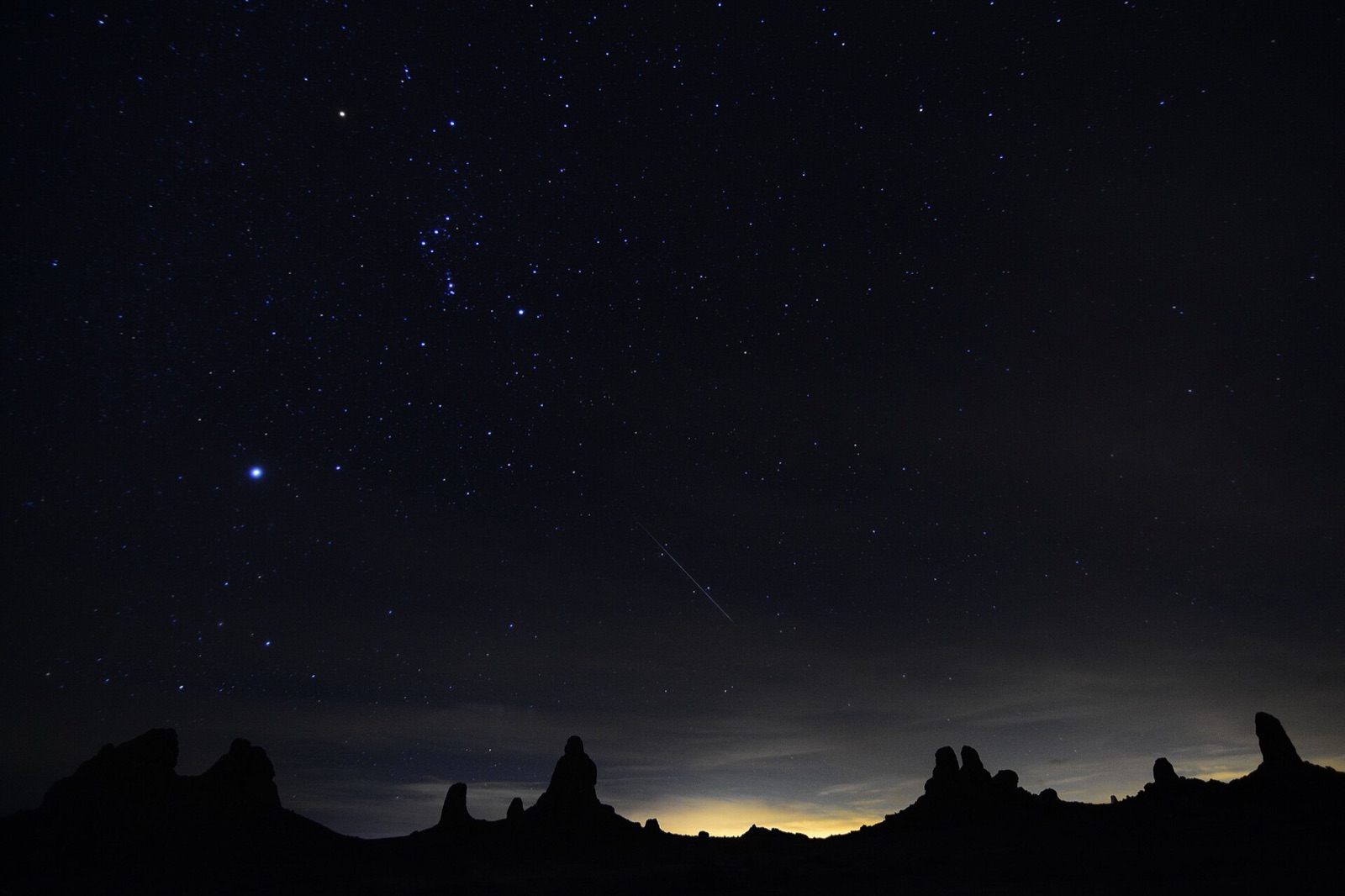
At 10 pm local in mid-December, from mid-northern latitudes, the winter sky fills the east and south. Orion is up in the south-east, and the Orion Nebula (M42) is an easy naked-eye smudge and a good 200–400 mm target. The Pleiades (M45) are at their highest of the year around 10–11 pm, near the zenith from 40° N. Gemini follows. The Double Cluster is high in the north-east, the Andromeda Galaxy (M31) is still near the zenith in early evening, and Sirius rises about 8 pm mid-month.
The Milky Way's core can't be seen from the north until spring. What's up instead is the winter Milky Way, the fainter outer arm from Cassiopeia through Auriga, between Orion and Gemini, and down past Sirius. It needs a dark site and the Moon-free nights of December 4–14, and it's fainter than the summer band, so it won't stand out on the camera screen.
From the southern hemisphere, Orion stands upside-down high in the north, the Magellanic Clouds are high in the south, and the nights are short.
Sun and twilight
In New York the Sun sets at 4:29 pm on December 1, reaches its earliest setting around December 8, and is back to 4:38 pm by December 31. Sunrise moves from 7:00 to 7:19 am and is still getting later after the solstice. The earliest sunset and latest sunrise don't fall on the solstice itself. Astronomical night lasts 11 h 17 min on the 1st (6:06 pm to 5:23 am) and 11 h 25 min on the 31st. In London sunset is 3:54 pm on the 1st and 4:00 pm on the 31st, with just over 12 hours of astronomical night at the solstice.
The solstice is at 20:50 UTC on December 21. No daylight-saving changes fall in December in the US or EU. ISS passes come in evening or morning runs depending on where you are. Check Sky Events → Satellites for this month's window at your location.
What to photograph this month
Three things we'd go out for.
- The Geminids, December 13–14. Be at a dark site by 10 pm, after the crescent sets. Use 14–24 mm at f/2.8, 15–20 s, ISO 3200, with the intervalometer running until dawn. The meteor shower guide covers stacking the catches onto one frame.
- The Cold supermoon rising, December 23 and 24. On the 23rd the Moon rises in New York at 3:58 pm, half an hour before sunset. On the 24th it rises at 5:15 pm, in deep twilight. You get two different pictures, and the 23rd is the easier one to expose. See the supermoon guide and the Moon-behind-a-landmark guide. Use 300–600 mm.
- Orion and the winter Milky Way, December 4–14. Any clear evening after 10 pm will do. Shoot a 24–35 mm frame from Sirius up through Orion to the Pleiades, tracked or stacked. See the Milky Way guide and the stacking guide.
Sky Events lists every event on this page for your own location in local time, with reminders. Open the 360° sky, set it to December 27 at 10 pm, and drag time forward to watch the Moon, Jupiter and Mars come up together.
FAQ
When is the full Moon in December 2026?
December 24, 2026 at 01:28 UTC, which is the evening of December 23 in the Americas. It's the Cold Moon and the closest full Moon of the year, with perigee at 08:30 UTC at 221,612 miles.
Is there a meteor shower in December 2026?
Two. The Geminids peak on December 13–14 (maximum 05:44 UTC on the 14th) with up to 120 an hour under a dark sky, and the crescent Moon sets by mid-evening. The Ursids peak on December 22 with 5–10 an hour under a nearly full Moon, so don't plan around them.
Which planets are visible in December 2026?
Saturn in the evening, high in the south at dusk. Jupiter and Mars rise in the east in Leo late in the evening, about 9:30 and 10 pm mid-month. Venus is the brilliant morning star from about 3:30 am. Mercury shows only in the first days of the month, very low at dawn.
What is the longest night of the year in 2026?
The December solstice is at 20:50 UTC on December 21, 2026, the longest night for the northern hemisphere, with about 11 h 20 min of astronomical darkness in New York and 12 h in London. Earliest sunset falls around December 8 at 40° N, latest sunrise in early January.
Sources and further reading
- Fred Espenak, Astropixels — Sky Event Almanac 2026 (GMT) (Moon phases, apogee/perigee, Geminid/Ursid dates, solstice, Moon–Pleiades and Moon–Jupiter, Mercury elongation; the 2027 almanac for the Jan 1 superior conjunction).
- timeanddate — Moon Phases 2026, UTC and Sunrise and sunset in New York, December 2026 (phase times, sunset/sunrise and twilight, moonrise on Dec 13, 23 and 24).
- EarthSky — Geminid meteor shower 2026 and Ursid meteor shower 2026 (peak times, rates, Moon verdicts, radiants, parent bodies).
- Obliquity SkyEye — Saturn in 2026, Venus in 2026 and Mars in 2026 (Moon–planet separations, ring-tilt minimum, Venus constellation change).
- ALPO, Jeff Beish — The 2026–2027 aphelic apparition of Mars (Mars magnitude and disc size, the February 19, 2027 opposition at 13.8″).
- timeanddate — Cold Moon (the Cold / Long Night / Moon Before Yule names; full-Moon distance and largest full Moon of 2026).