Comets
How to Photograph a Comet: Finding It, Framing the Tail and Settings That Work
A bright comet is the one night-sky subject you can't plan years ahead. Meteor showers come back on the same dates and eclipses are known centuries in advance. A naked-eye comet is found months before it peaks, nobody knows how bright it will get, and it's usually at its best low in twilight, close to the Sun. So how to photograph a comet is mostly a question of planning: where it will be on a given evening, how high it is when the sky is dark enough, and how long you can expose before the comet itself blurs. The camera settings are the easy part.
At a glance
- Settings, dark sky: f/2–2.8, 5–30 s untracked, ISO 1600–6400. On a tracker, 30–120 s subs. Manual focus on a star, RAW.
- Settings, twilight: f/2.8, 1–4 s, ISO 400–1600. The bright sky sets the exposure.
- Lens: 24–50 mm for a long tail over a landscape, 85–200 mm for the coma and tail structure, 300 mm and up on a tracker.
- When: the days after perihelion, at the end of astronomical twilight if the comet is high enough, otherwise in nautical twilight. Check the Moon.
- Afterwards: stack short frames twice, on the stars and on the comet, and combine.
What you're photographing: coma, dust tail, ion tail
A comet is a nucleus of ice and dust, typically a few miles across and rarely more than 10 miles, darker than coal. Near the Sun its ices sublimate and release gas and dust into a coma that can grow larger than a planet. That's the fuzzy head you see in your photos. Sunlight and the solar wind push the material into two separate tails.
.jpg)
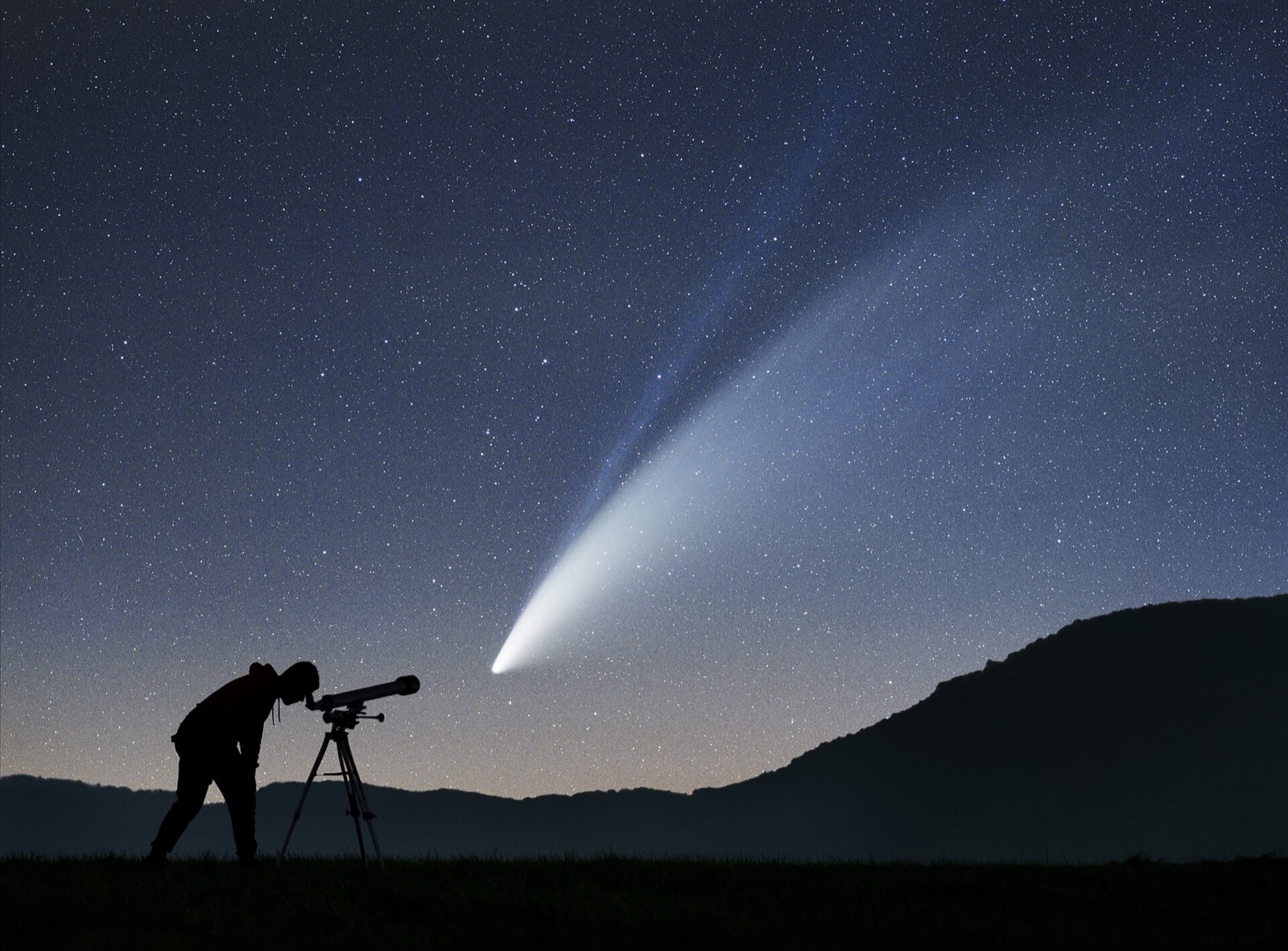
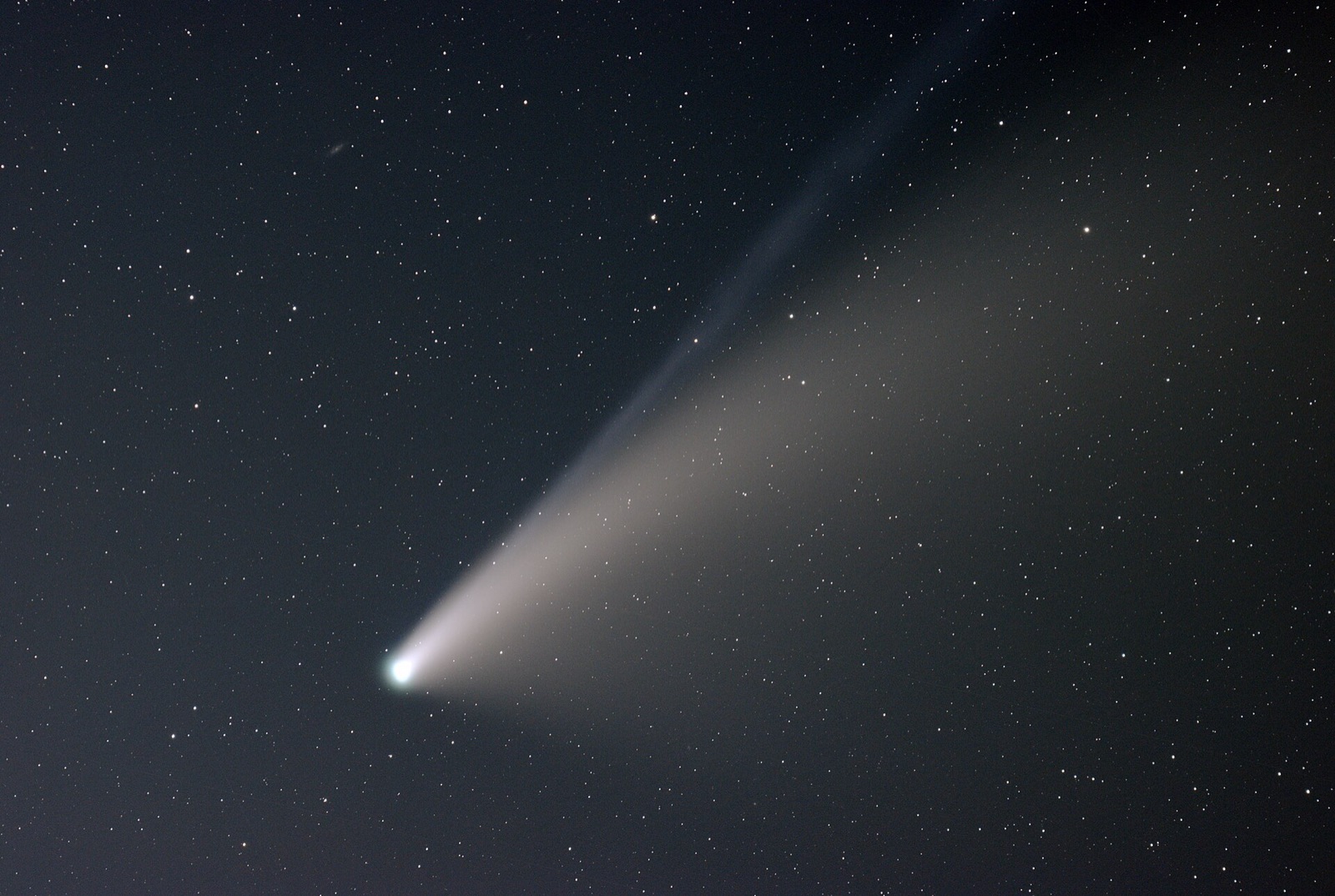
- The dust tail is grains the size of smoke particles, pushed out by radiation pressure. It shines by reflected sunlight, so it looks whitish-yellow, and because the grains lag along the orbit it curves gently toward the comet's path. It's the broad, bright tail you see by eye.
- The ion tail is charged gas carried by the solar wind. It glows blue, mostly from carbon monoxide ions, and points straight, directly away from the Sun. It's narrow, faint, structured, often much longer than the dust tail in photographs, and can kink or disconnect when the solar wind gusts.
Occasionally an anti-tail appears, a spike that seems to point toward the Sun. It's usually an effect of perspective. When Earth crosses the comet's orbital plane, we see the sheet of large dust grains spread along the orbit edge-on, and it appears to point toward the Sun. Tsuchinshan–ATLAS showed one on 14 October 2024. Both real tails point away from the Sun, never behind the comet's motion, so after sunset the tail rises up and away from the western horizon. When you frame, leave room in the direction the tail points, not the direction the comet is moving.
Why comets are unpredictable
A comet's brightness depends on how much gas and dust it sheds, and nobody knows that until it happens. Comets arriving from the outer Solar System for the first time often brighten early as fresh ice sublimates, which makes the forecast too high, and then fade. Kohoutek in 1973 is the usual example. Others break up near perihelion, as C/2019 Y4 (ATLAS) did in April 2020. Returning periodic comets are more predictable because we have records of their earlier apparitions. Geometry matters too. A comet passing between Earth and the Sun can gain several magnitudes from forward scattering and lose them again in days. So a forecast made months ahead can be wrong by a magnitude or two. David H. Levy put it in Comets: Creators and Destroyers: "Comets are like cats: they have tails, and they do precisely what they want." So don't decide from the forecast alone. Go out on the first clear night the comet is well placed, look at it, and adjust your plans.
Comet names, perihelion dates and where to hear about the next one
Designations follow the IAU scheme run by the Minor Planet Center. The prefix gives the orbit: C/ non-periodic (or a period over 200 years), P/ periodic, D/ broken up or lost, X/ no reliable orbit, I/ interstellar. Then the discovery year, a letter for the half-month (A = 1–15 January, B = 16–31 January, and so on, skipping I) and the order of discovery within it. C/1995 O1 (Hale–Bopp) was the first comet found in the second half of July 1995, and C/2023 A3 (Tsuchinshan–ATLAS) was the third found in early January 2023. The name in brackets is the discoverer or survey, with up to three names joined by hyphens.
Two dates matter. Perihelion is closest to the Sun, when the comet is usually most active. Perigee is closest to Earth, when it's largest in the sky and moving fastest. They're often weeks apart, and the best views usually come in the days after perihelion, as the comet moves out of the Sun's glare with its tail fully developed.
Bright comets are found by surveys such as ATLAS, Pan-STARRS and ZTF months to two years ahead. Once the orbit is published the path is known precisely. Use the Minor Planet Center for ephemerides (right ascension and declination for any date). COBS, the Comet Observation Database, collects observers' brightness estimates, so it's the best place to check how bright the comet is right now. EarthSky and Sky & Telescope publish finder charts.
Still Dark doesn't track comets, but you can use the 360° sky to plan the shoot. Set the date and time, search for the star or planet nearest the comet's published position, and read off its altitude and azimuth. That tells you whether the comet clears your horizon at the end of twilight and which way to face. The Sun & Moon card gives civil, nautical and astronomical twilight for the same evening, and Moon Details shows phase and rise/set for a Moon-free window.
When to photograph a comet: twilight or dark sky
Comets are brightest near perihelion, and near perihelion they're near the Sun in the sky. A comet 0.3–0.4 AU from the Sun can never appear more than about 17–24° from it, so it sets an hour or so after the Sun, or rises an hour or so before it, low while the sky is still bright. You always have the same choice. You can shoot a brighter comet in a brighter sky now, or a fainter comet in a dark sky a week or two later.
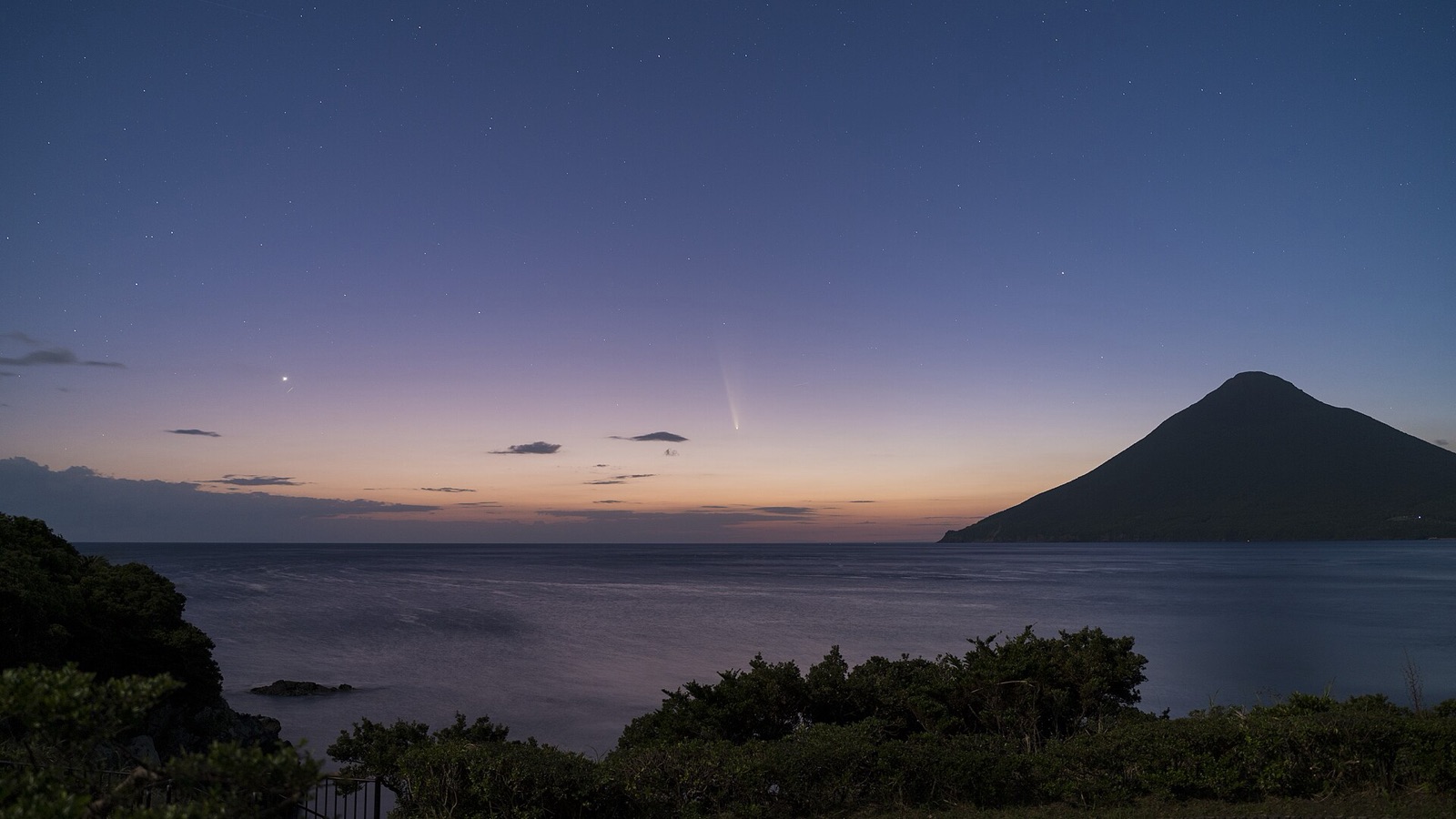

- Evening apparition: the comet sets after the Sun. Look west from the end of civil twilight. Each day after perihelion it's usually higher and sets later, but it's also fainter.
- Morning apparition: the comet rises before the Sun. Look east from the start of nautical twilight. You lose it once civil twilight begins.
- Altitude: below 10° the tail fades into thick air and haze. An altitude of 15–20° at the end of astronomical twilight is good.
Work backwards from the end of astronomical twilight. Find that time and the comet's altitude then. If it's already under 10°, shoot in nautical twilight and accept a brighter sky and a shorter exposure. Tsuchinshan–ATLAS in October 2024 is a good example. It peaked near magnitude −4.9 on 9 October, but only a few degrees from the Sun. The usable evening window opened around 11–12 October, low in the west in twilight. By the 20th it was a dark-sky object of about magnitude 3. If civil, nautical and astronomical twilight are new terms, the twilight guide explains them.
How to find a comet in the sky
- Get the position for your date: RA and Dec, or the constellation and a nearby bright star from a finder chart.
- Place it in the 360° sky at the time you'll be out, and note the direction, altitude and neighbouring stars.
- Scan with binoculars first. A magnitude 3–5 comet in twilight is easy in 7×50s and hard with the naked eye until you know exactly where it is. Sweep from the star you're using as a guide. The coma looks like an out-of-focus star with a fan on one side.
- Then use the camera. A 5-second test frame at ISO 6400 with a 50 mm lens shows the coma and the start of the tail before you can see them by eye. This is the most reliable way to find it.
Framing and focal length: which lens for the tail
Choose the lens by the length of the tail. A great comet spans 20–45° of sky. Ordinary bright comets show 5–12° to the naked eye and 20–40° in long-exposure stacks.

| Comet | Peak magnitude | Tail | Notes |
|---|---|---|---|
| C/1996 B2 (Hyakutake) | ≈ 0 (Mar 1996) | up to ≈ 80° | Passed 0.1 AU from Earth on 25 Mar 1996. Moved ½° every 30 minutes. |
| C/1995 O1 (Hale–Bopp) | ≈ −1.8 (Apr 1997) | 40–45° dust tail | Visible to the naked eye for a record 18 months. Nucleus ≈ 37 mi. |
| C/2006 P1 (McNaught) | ≈ −5.5 (Jan 2007) | ≈ 35° | Visible in daylight 12–14 Jan 2007. Southern hemisphere. |
| C/2020 F3 (NEOWISE) | ≈ 0.5–1 (Jul 2020) | 10–12° naked eye. In photos ≈ 25° dust, ≈ 40° ion tail | Perihelion 3 Jul. Morning object, then evening from mid-month. |
| C/2023 A3 (Tsuchinshan–ATLAS) | ≈ −4.9 (9 Oct 2024, forward scattering, near the Sun) | 5–7° naked eye / binoculars mid-Oct. 20°+ in photos | Perihelion 27 Sep, perigee 12 Oct, anti-tail 14 Oct. |
- 24–50 mm: the whole tail in a landscape (a 35 mm covers about 54° × 38° on full frame). Put the comet in a corner with the tail running diagonally.
- 85–200 mm: the coma and the first 5–15° of tail (a 135 mm covers about 15° × 10°). At this focal length you can see the two tails separate, and the yellow of the dust tail against the blue of the ion tail.
- 300 mm and longer: the coma, jets and tail root, on a tracker. Without a tracker you can only expose for a second or two.
Comet camera settings: the comet moves too
All the rules for sharp stars apply, and there's one more. The comet moves against the stars, usually by arc-minutes an hour, but by about 1° an hour for a comet passing 0.1 AU from Earth, as Hyakutake did. At that rate a 30 s frame at 200 mm trails the nucleus by about five pixels while the stars stay sharp. The NPF or 500 rule gives the longest exposure for sharp stars (see the 500 rule and NPF rule). The comet's speed gives the longest exposure for a sharp coma. Use whichever is shorter.
| Scenario | Lens | Aperture | Shutter | ISO | Why |
|---|---|---|---|---|---|
| Bright comet in twilight, low | 24–85 mm, tripod | f/2.8 | 1–4 s | 400–1600 | Expose for the sky. Shoot bursts as it darkens. |
| Naked-eye comet, dark sky | 24–50 mm landscape or 85–135 mm detail, tripod | f/2–2.8 | 5–30 s (NPF limit) | 1600–6400 | Shoot many short frames to stack. The ion tail needs a lot of total exposure. |
| Binocular comet (mag 5–8), tracker | 135–300 mm, tracked | f/2.8–4 | 30–120 s subs | 800–3200 | 20–60 minutes total. The comet's motion limits sub length, so shoot more subs. |
For everything else, use manual mode, RAW, and noise reduction off. Focus on a bright star at 10× before the comet appears, and tape the focus ring so it can't move. Set the aperture wide open or one stop down. Set white balance to 3800–4500 K so the ion tail stays blue. Run the intervalometer continuously with a one-second gap. You can also photograph a magnitude 0–2 comet in twilight with a phone. Use a tripod and Night mode at 3–10 s, with the comet low over a horizon (see the phone astrophotography guide). If the comet is fainter than magnitude 3, a phone records the coma but not the tail.
Stacking and processing comet photos
A stack aligned on the stars blurs the comet, and a stack aligned on the comet streaks the stars. The fix is to align the same frames twice. Make a star-aligned stack and a comet-aligned stack (register on the nucleus, marked in the first and last frame, with sigma-clipping rejection to remove the trailing stars), then combine them with a mask around the comet and tail. Siril has a Comet/Asteroid registration method and a tutorial for this. DeepSkyStacker offers standard, comet and stars + comet modes. For a landscape on a tripod, Sequator aligns the sky and keeps the ground still. With a wide lens over 10–15 minutes the comet moves a pixel or two, so a plain star-aligned stack is fine. You need the two-alignment method from about 135 mm up, or for a fast comet near perigee.
Go easy on the processing. The coma is bright and the tails get faint quickly. If you stretch until the tail fills the frame, the sky goes blotchy and the ion tail turns to noise. Stretch in small steps, keep the coma from clipping, keep the background dark grey and not black, and raise the blues slightly so the ion tail stands out from the yellow dust. A tail fades out gradually and has no hard edge, so use very little sharpening, or none.
Planning checklist
- The Moon. A comet is a low-contrast, extended object, and a Moon past first quarter in the same half of the sky washes out the tail. Find a Moon-free window (see Moon phases for photographers).
- Twilight. Note the end of civil, nautical and astronomical twilight and the comet's altitude at each. That gives you your window, which is usually 30–60 minutes.
- The horizon. A perihelion comet sets or rises within a few tens of degrees of the Sun's azimuth. Pick a flat horizon in that direction and check it in daylight. Low cloud and haze matter more for a comet than for any other subject.
Common mistakes
- Looking on the wrong side of the sky. An evening comet is in the west after sunset, a morning comet in the east before dawn, not at midnight.
- Giving up because the forecast said magnitude 2 and it's magnitude 5. A fifth-magnitude comet with a tail is a fine photograph under a dark sky.
- Exposures too long for the comet. A 2-minute frame at 200 mm of a comet near perigee stretches the coma into an oval. Stack short frames.
- Forgetting the twilight timing. A perihelion comet's window is in nautical twilight and lasts only minutes. If you arrive at astronomical twilight the comet has already set.
- Not shooting the ion tail with a longer lens. In a 24 mm frame it's only a smudge. Add a 135–200 mm sequence.
FAQ
How to photograph a comet: what camera settings should I use?
Dark sky: f/2–2.8, 5–30 s depending on focal length, ISO 1600–6400, manual focus, RAW, shooting continuously for stacking. Twilight: f/2.8, 1–4 s, ISO 400–1600. Tracked: 30–120 s subs, short enough that the comet's own motion doesn't blur the coma.
Why can't I see the comet when the chart says it's there?
Usually it's lower or fainter than expected and the sky is still bright. Wait, sweep with binoculars from a nearby bright star, and take a 5-second test frame at high ISO. The camera will show it before you can see it.
Why does a comet's tail point up instead of behind it?
Tails point away from the Sun, not behind the comet's motion. After sunset the Sun is below the western horizon, so the tail rises up and away from it.
Is an evening or a morning comet better?
Neither is brighter. It depends on which side of the Sun the comet is. Evening comets set after the Sun in the west, morning ones rise before it in the east, and the same comet often switches within a fortnight of perihelion. NEOWISE in 2020 and Tsuchinshan–ATLAS in 2024 both did.
Sources and further reading
- ESA — Structure of a comet (dust tail whitish-yellow and curved; ion tail blue, aligned with the solar wind).
- NASA Space Place — What is a comet? (two tails; the ion tail points directly away from the Sun; nucleus under 16 km).
- IAU Minor Planet Center — Cometary designation system (year, half-month letter and number; the P/, C/, X/, D/ and A/ prefixes).
- Wikipedia — Hale–Bopp, Hyakutake, McNaught, NEOWISE, Tsuchinshan–ATLAS and Antitail (magnitudes, tail lengths and dates in the table; the anti-tail mechanism).
- Siril — Working with Comets (comet/asteroid registration and the two-stack workflow); Jerry Lodriguss — DeepSkyStacker comet stacking (the three comet modes).
- COBS — Comet Observation Database (current observed brightness); Royal Observatory Greenwich — How to photograph comets (exposure and focal-length guidance).